Savor the Season
By Chef K. Marie Paulk
Here we are in the middle of summer. Can you believe the year is almost halfway over? It’s time to start thinking about how to enjoy the fruits and vegetables of the season. If you’re thinking that I’m going to be covering summer cooking, you are correct! If you guessed grilling, you would be incorrect. I’m instead going to discuss the next best thing: summer soups. It may not sound as exciting as grilling a ribeye, but it really can be just as flavorful.
My favorite is the import from Spain, gazpacho, but with a twist—a creamy gazpacho. For centuries Spanish field workers combined their leftover odds and ends to make a tasty potage. The tomato wasn’t even added to the soup until the explorers brought it back from the New World. Every region of Spain prides itself on its version of gazpacho, but Spain’s southernmost region, Andalusia, is the soup’s true home.
This recipe is a simple blend of cucumbers, bell peppers, onions, tomatoes, and bread added for body. I would recommend a few modifications to make a creamy gazpacho. When adding the olive oil, drizzle it in so the mixture can emulsify, creating a silky texture. Avoid English cucumbers, as they have higher water content than regular cucumbers, which only require a few extra minutes to scoop out the seeds. Salt your vegetables at least an hour before you purée. Also, before you purée the vegetables, put them in a strainer and capture the vegetable liquid in a bowl. Soak your bread in that vegetable liquid before you add it to the soup. If you make the gazpacho the night before, it will allow the flavors to intensify, much like a tomato sauce, and you will have a richer tasting soup. Sound simple enough? But what about all the other vegetables available to us now, like asparagus, carrots and sweet peas?
Grilled asparagus is great, and it’s just as good blended and made into a soup. Freshness is key; if they give off an unpleasant odor, they’re too old. The ends should be moist, not dried out. To keep the asparagus fresh, stand the spears in shallow water in your refrigerator, but do so only for a couple of days. Some feel the thicker spears are the more tender and sweeter — and for a soup, I prefer them — but I would favor the thinner ones for grilling. White and purple asparagus are now more commonly available, too. The white varieties are mounded with soil to keep the sunlight out, because the spears develop in darkness (they don’t produce chlorophyll). Their skin is a bit tougher and the flavor is milder. If you happen to find purple asparagus, add vinegar or lemon juice to the spears before cooking to prevent their discoloring. A purple asparagus soup would be very pretty and a great way to stump your guests. I use a sautéed leek and yellow onion along with a homemade vegetable stock for my asparagus soup to make it even more flavorful.
Now, carrots—one of my favorites. I love their many colors, from purple to white, and their shapes, slender to chubby. Their flavor, however, is what I love the most. Luckily, carrots are available throughout the year at the local grocery store and are always good! I find the carrots with the best flavor are those that are harvested in the late spring and early summer. Carrots from late summer to early fall have a more complex and sweet flavor, which is the result of the colder temperatures converting the roots’ starches to sugars; roasting these carrots is the best option. The shelf life for a carrot is relatively short: baby carrots hold up for about five days and a more mature carrot should last about two weeks. As such, store your carrots in the coldest part of the refrigerator and keep them in a plastic bag. The combination of ginger, fennel, leeks, and carrots make a wonderful soup.
While not my favorite, I know that split pea soup remains very popular. The sweet pea is hard to find and keeping them fresh is the issue. The travel time between the growers and the market is even enough to dry up their juices, turning the sugars into a starch. The pod should appear swelled—but not too big, or you will find the peas inside will be too starchy. If the pods are too small, the pea will probably not be larger than a small bead. The peas themselves should look moist and not too big. Fresh sweet peas, spinach, and coconut milk will make a delightful soup.
There are a lot of ideas for summer soups, which could be an added treat on a summer day. Grilling and a cool soup for dinner will always make a winning combination. As an added plus to making your own, you can control the sodium, mainly by using Kosher salt instead of table salt. If any of these recipes seem interesting, I will post them on the Local Happenings website. So enjoy all the gifts we’re about to receive from the earth (fruits included)—the season won’t last very long.
Are They Worth It?
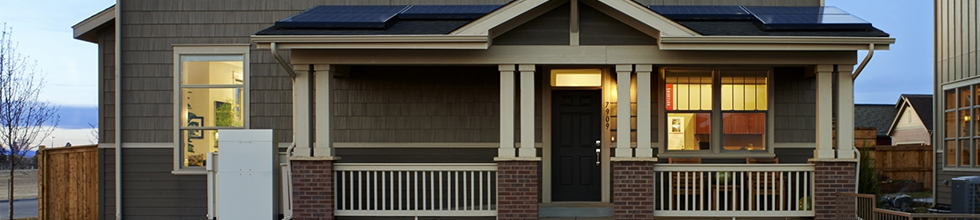
Living today, in the 21st century, many of us think about the future and how we can better conserve the energy that we use, whether for financial or environmental reasons (or both). Prime examples that are buzzing around home and building design are zero-energy buildings (ZEBs), also known as net-zero energy buildings (NZEBs) or zero-energy homes. A zero-energy building or home is just as it sounds—a place that has zero net-energy consumption. Although the ZEB concept is fairly new, it is clearly defined by energy.gov as “an energy-efficient building where, on a source-energy basis, the actual annual delivered energy is less than or equal to the on-site renewable exported energy.” In other words, the goal is to use renewable energy (from a source that is not depleted when used, such as wind or solar power) to offset energy consumption.
It sounds great, to conserve energy while also conserving funds, because the building makes renewable energy—however, if you are like most of us (who use electricity for just about everything), the idea may seem next to impossible, at first…
Most would agree that the average person uses a lot of energy, especially in how most technology relies on it. According to zeroenergyproject.org, “Buildings alone are responsible for 40% of the total energy used in the United States.” In terms of energy, most homes and buildings use electricity, heating energy, cooling energy, and fuels—that is, most standard homes and buildings require heating, cooling, ventilation, domestic hot water, lighting, and plug loads.
ZEBs are great because they not only help the environment (e.g. fossil-fuel free), but they also help homeowners and businesses save money. The electrical grid provides most ZEBs for about half or more of their energy while later returning the same amount (and sometimes more).
Of course, it’s almost inevitable that you’ll end up needing the A/C, heater, and the water heater. However, ZEBs often use air-source heat pumps on their water heaters (it takes hot air from the room to heat water). During the summer, it helps cool the house. In the winter, the heat pump can be turned off to run full electric—even though it’s more expensive and uses more energy (the electricity cost is offset by the savings made in the summer).
If you’re like me, you don’t look forward to utility costs such as the PG&E and water bills—which are not going down—especially after the San Bernardino fire incident and California drought. For those who don’t remember, last winter was super cold, and with the summer heat already here, I’m using my classroom’s A/C almost every day.
As such, finding ways to conserve energy in order to save money and time (spent to re-heat or re-cool an area) seems like common sense to me. Some simple ways include keeping windows and doors closed, especially when running the A/C or heater.
However, learning to master energy conservation and renewability through proper home and building design is what is key to ZEBs. Of course, ZEBs take keeping windows and doors closed to the next level by using highly insulated windows and doors in their design. Zeroenergyproject.org states, “Windows and doors are like big energy holes in a well-insulated, airtight building envelope, and are the third most cost-effective strategy for making a home energy efficient. Control window-and-door heat loss and gain by selecting appropriate window and door products, carefully locating them, and optimizing their size and orientation.”
Another critical component to ZEB design is exploiting solar energy. Zeroenergyproject.org elaborates: “Using the sun for heating through south-facing windows during the winter lowers heating costs. Shading those same windows in summer lowers cooling costs.” Solar energy is free energy that we should take better advantage of. The best part of ZEB design is that it does not require expensive solar paneling like some people may initially think, though they can be added as an additional investment.
ZEBs are also known for being extremely airtight. Walking into a well-designed ZEB, you would feel no air (unless the building’s air is on, of course). To accomplish this goal, ZEB builders and designers pay a lot of attention to a building’s envelope (an envelope refers to the physical separator between the conditioned and unconditioned environment of a building), specifically its thermal envelope. Builders often install foam in the center of the foundation, and concrete on the building’s interior and exterior. Robert (Bob) Dykins—a ZEB builder who constructed the first LEED (Leadership in Energy and Environmental Design) gold-certified home in Connecticut in 2007—explains: “In doing that, it’s like putting wool socks onto your house. It keeps the cold out from the ground up. There’s a lot of insulation underneath the slab [concrete] with a lot of attention to moisture migration in the foundation, which, in the long run, will keep the house healthier by not introducing unneeded moisture.”
Because designing or moving toward a ZEB has gone from a concept to a reality, it has gained national attention for sound reasons—namely in that ZEBs are wise investments that will help homeowners and businesses save money and the environment in the long run.
To learn additional information, I encourage you to go to zeroenergyproject.org, energy.gov, and www.wbdg.org.
 James Quinn lives in Benicia and teaches at Elmer Cave Language Academy in Vallejo. A UC Davis alumnus in English, he now studies education as part of Touro University’s Master’s in Education program. Along with teaching, he tutors and writes often. He is working on a novel that takes place in Benicia. See his website at mrquinnj.weebly.com.
Art, Wine, Music…and pets?
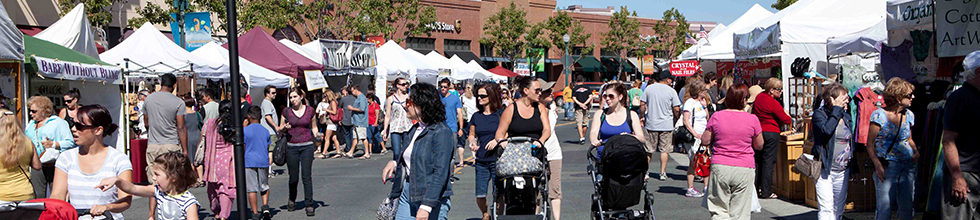
Over the past 15 years, the Pleasant Hill Chamber of Commerce has brought more than 150,000 people to the city to listen to music, sample wines, and enjoy the arts. Many attendees leave with a sculpture or painting, bottle of micro brew, or a CD from a local band.
But starting this year, folks who visit the Pleasant Hill Art, Wine and Music festival on October 7th and 8th can come home with something else: a lifelong friend. That is because this year the festival is teaming up with former Major League Baseball manager Tony La Russa’s Animal Rescue Foundation and Contra Costa Animal Services to offer pet adoptions to the public for both days of the festival.
Each year since 2003, the Pleasant Hill Art, Wine and Music Festival has put the small city in the local spotlight. The Pleasant Hill Chamber of Commerce, a tiny organization that relies heavily on local volunteers, organizes the festival. In recent years, crowds totaling 10,000-15,000 have flocked to the two-day event for wining and dining, as well as for a chance to immerse themselves in music and the arts.
“A lot of the same artists come year after year,” said Steve Van Dorn, president and CEO of the Pleasant Hill Chamber of Commerce. “They love coming to our events.” “We get a good range of art and crafts … It’s everything from glass art, to photography, to paintings, candles, tie dye shirts and even statues of bears that are carved out of wood.”
The decision to open the festival to pet adoptions made sense as a natural progression for the festival, which has always tried to be animal friendly, according to Van Dorn. Its organizers made the unusual decision years ago to allow attendees to bring their dogs, but this year they will have an entire animal section. In addition to the adoptions, the festival will have animal demonstrations that include a presentation by a local police K9 unit from the Pleasant Hill Police Department.
“I think any successful chamber tries to do events that are focused around five pillars, and one of them is to bring the community together,” Van Dorn said. “That’s what these events do, they bring people together, including folks from other cities around the Bay Area, and everyone just has a great time.”
The festival originated as a fundraising idea, not just for the chamber, but also for local businesses. The Chamber of Commerce is tasked with promoting area business and encouraging folks to come spend money downtown to empower the local community. For years, however, chambers all over the Bay Area have been forced to get creative when it comes to raising money. The Pleasant Hill Chamber relies heavily on the Wine, Art and Music Festival, though it also holds monthly mixers and regular events, such as July’s Blues and Brews Festival (a two-day outdoor concert that was free and open to the public).
“Today as a chamber, it’s difficult to survive on membership dollars alone,” Van Dorn said. “If we didn’t do this event we might not be able to survive as a chamber; it’s that crucial to our sustainability.”
The festival has moved around over the years, but it settled into a section of downtown Pleasant Hill that is centered on a semi-circle section of Crescent Drive, a short distance from the Century Movie Theater. Throughout both days, there will be live music from local bands, at a stage right next to the popular Jack’s Restaurant & Bar. Visitors will be able to browse beautiful work from more than 70 artists who will be stationed at booths, with food and beverage booths interspersed between them.
“We hope to bring revenue into local businesses, and that folks who come out might stay for dinner or visit our stores,” Van Dorn said. “That’s why we have it downtown, so people can come see what we have to offer throughout the city.”
The main attraction is a Saturday night concert that is put on by the popular local group East Bay Mudd (apparently a playful take on the name of the local water agency, East Bay Mud). The nine-member band has been around for 15 years and features a four-piece horn section. They bring a repertoire of classic soul and R&B tunes, and the will play into the night.
“They’re very good, and the place really gets going,” Van Dorn said. “It’s just crazy out there… That’s one of the special things we do that’s different from most art, beer, and wine festivals.”
Folks who are interested in sampling beer and wine flavors will have many options. There will be wine and beer booths throughout the festival, featuring all the usual suspects—national brands like Budweiser—as well as sectioned-off areas for micro-brewed beers and a wine pavilion that is sponsored by Total Wine and More. Van Dorn said to expect “very high-level wines,” and that there will be around a dozen microbrews on tap. The microbrew area will be adjacent to the Kid Zone as well, so “parents can be right there with their kids and have a cold one at the same time,” Van Dorn said.
The Kids Zone will feature games and activities like a jump house, ball pit, and a climbing wall, as well as another stage for music and entertainment geared towards a younger audience. And to make it even easier on parents, there will be a number of food trucks right nearby, “so parents don’t have to walk all the way across the event to get food for their kids,” Van Dorn said. Food trucks are nothing new to Pleasant Hill, which has become a popular off-the-grid destination since 2014.
Despite the expected crowd of 5,000-7,500 per day, do not worry; you will not be circling the block 50 times looking for a place to park. According to Van Dorn, for the duration of the festival, three-hour parking signs in the area will be covered up and longtime parkers will be given amnesty. The parking lot of the nearby Orchard Supply Hardware will also be opened up for festival attendees.
“It’s unlimited parking, basically,” Steve said. “We don’t have problems with parking; it’s never come up in our surveys or feedback from the people who come.”
Each year, the festival continues to grow and add attractions. “The local community is largely to thank. Those who have come year after year to organize the event and stick around to make sure things go smoothly have made all the difference,” Van Dorn said.
“We have a committee of volunteers who do so much work. We could never do it by ourselves. The folks in our community step up and make it happen every year,” he continued. “Hopefully we’ll have tremendous weather, and everyone who comes to check it out has a great time.”
The Pleasant Hill Art, Wine and Music Festival will begin at 10 AM Saturday, October 7 and end at 6 PM. The East Bay Mudd concert on Saturday will kick off at 6:30 PM, and it is expected to continue until around 8:45 PM. On Sunday, the festival will run from 11 AM to 5 PM. For additional information, call (925) 687-0700 or visit www.pleasanthillchamber.com/pages/ArtWineMusicFestival.
 Nate Gartrell grew up in Benicia, studied journalism in college, and has written for a handful of media outlets since age 15. He aspires to visit all 30 Major League Baseball stadiums and to hit the trifecta at the horse track.

Supporting Breastfeeding for the Optimal Health of Infants and Mothers
August 1st – August 7th is World Breastfeeding Week, celebrated throughout the world to bring awareness of the importance of breastfeeding and breastfeeding support for women and children. This year marks the 25th anniversary of World Breastfeeding Week, with celebrations internationally and locally in Vallejo. There is significant evidence to the benefits of breastfeeding, not just for the infant, but lifelong benefits for both mother and child.
Benefits of Breastfeeding
Breastmilk contains thousands of various components including living cells and antibodies that fight to protect a child’s immune system and set the stage for healthy growth and development.
- Living cells and antibodies in breastmilk protect the infant from illness. When a mother is exposed to bacteria or a cold, her body begins to develop antibodies to the illness. These antibodies (along with many others) are passed directly through the breast milk to provide protection for the child.
- Breastfeeding protects against ear infections, upper and lower respiratory infections, asthma, and the development of allergies.
- Breastfeeding lowers the risk of sudden infant death syndrome or SIDS.
In addition to the benefits of breastfeeding for the child, there are also a host of benefits to mothers.
- Breastfeeding after the birth of a child contracts the uterus, helping the uterus return to its pre-pregnancy size and control post-partum bleeding.
- Breastfeeding can lower the risk of both breast cancer and diabetes, especially among women who breastfeed for at least a year.
- Breastfeeding burns extra calories, helping some women return to their pre-pregnancy weight faster.
There are other practical benefits too.
- Breastfeeding is free. There is no need to purchase expensive formula.
- Breastmilk is ready anytime, anywhere. You do not need to plan and prepare before your baby is ready to eat.
- There are no bottles or rubber nipples to clean.
Breastfeeding Recommendations
The American Academy of Pediatrics recommends exclusive breastfeeding in the first six months, breastfeeding for at least 12 months and continuing thereafter as long as mother and baby would like. According to the Centers for Disease Control and Prevention, approximately 80% of infants were breastfed in 2013 across the United States. In California, 90.2% of infants breastfed, with 51% exclusively breastfed until 3 months and just over 24% exclusively breastfed until 6 months. This data means while many women are trying to breastfeed many more are not successful at exclusively breastfeeding for the first 6 months. What can we do as a community to support breastfeeding?
We Can All Be Involved: Breastfeeding Promotion and Support
This year the theme of World Breastfeeding Week is “Sustaining Breastfeeding Together.” At the international level, that means bringing together a diverse set of activists, decision-makers, health experts, and various partners to identify barriers and successes in promoting and supporting breastfeeding worldwide. Locally, it means that we all need to work together to promote and support breastfeeding for the health and wellness of infants, babies, mothers, and families. Whether you are a new or expecting parent, support person for a new family, childcare provider, or employer, you can help support breastfeeding. Offer to bring a new mother a meal or help with chores around the house; this way the mother can focus on her baby.
Look into local resources, such as the Solano County Breastfeeding Coalition, which has resources and contact information for support. In addition, Solano County Hospitals, Solano County Health and Social Services, local WIC offices, pediatric clinics, La Leche League, or lactation consultants in the area can provide support.
By Carly Strouse, DrPH, MPH
Assistant Professor, Community Health
Touro University California Public Health Program
A Deliciously Hidden Gem in Benicia
Here is a hidden gem in my hometown of Benicia—Whipt Baked Goods, and chances are that you probably have passed this new business without even noticing.
Whipt is located on East 2nd Street, in a white-colored building that is inside the Lee Professional Plaza. It is right next to the Benicia Cat Clinic and across the street from Rrags Caffe and Nation’s Giant Hamburgers. When the white and pink Whipt tent is out, you will know it is open.
I want to first clear the air and let you know that Whipt is more than just a bakery––it bakes custom goods with local, organic ingredients and caters while also providing freshly baked goods during walk-in times. Of course, with Rosanna’s European Delights and now Diana’s Bakery on 1st Street, it may seem excessive to have that many bakeries in such a small city at first—but they are all unique in their own way, specifically in what they provide, and their locations (i.e., Diana’s is right across the street from the Benicia State Capitol, while Rosanna’s specializes in European goods and has been in Benicia the longest at its water-view location).
I experienced Whipt for myself during one of their walk-in Wednesdays on “Whipt Wednesday.” I saw and was greeted by my new friend, Whipt’s owner and creative mind, Krizelda Osada, though she goes by Krizy. I was also greeted by a friendly girl who told me about each of the gourmet goods in the display case, such as the blueberry scone that sounds even more amazing when warmed up. Other choices were gourmet “cookiecakes” like the red velvet cookiecake or the snickerdoodle cookiecake, beautifully garnished with almonds and drizzled with frosting—delicious art. The girl explained that the cookiecakes could also come “naked” (without garnish).
Out of all the choices, the Whipt French toast looked the best at the time since I had not eaten breakfast. I was also offered an iced coffee, and I immediately wanted that as well—very refreshing on a hot day. Without a long wait at all, everything was freshly made to safely take back home in a nice white box.
But before I left, Krizy let me try her summer chili, which she told me is “organic, from grass-fed cows.” The chili was nice and warm with melted cheese, hefty chunks of meat, and a nice zing to it that was not too spicy—just the way I like it. She also gave me one her most popular goods, the chocolate chip cookiecake. From the very first bite, I tasted why they are so popular because I now want to order a dozen—try one and get Whipt!
In addition to the goods, what I like about Whipt is all the passion that goes into the business. Krizy works hard doing what she loves, and she was passionate about baking before even starting her business. “I baked through college,” Krizy said, “as a way to decompress after stressful final exams. I baked with my nieces and nephews when they were little, as a way to share time with them. I baked through tough pregnancies to cope with the pain and nausea.”
My favorite story was about how Krizy baked through the labor of her children. “My husband would try to hurry me out of the kitchen and into the car,” Krizy said, “so that he could rush me into L&D at Alta Bates Hospital in Berkeley. For the labors of all three of my babies, I refused to go to the hospital until my batch of chocolate chip cookies were done baking, cooling and bagged up. At check-in for each of my children’s deliveries, I would present my nurses with a bag of my fresh baked, homemade chocolate chip cookies. I was told everyone loved them!”
Whipt first started out as a home-based operation with a dream to expand, and working hard and building rapport with people really helped make that happen. Krizy was the first to get a Cottage Food Permit in January of 2013. “Being the first trailblazer within the Cottage Food industry gave me the stage to make some noise. The local news was interested in this new permit, what it would mean to the home-based baker’s in California,” Krizy said.
Krizy made connections with old and new local businesses to sell her goods with them, such as in the old candy shop that used to be on 1st Street in Benicia (anyone remember Spoonful of Sugar?). She also vended at my favorite coffee place, Moschetti Artisan Roaster in Vallejo, during their Saturday tasting events.
Her business really took off when she sold at the Soma Street Food Park, a place that had food trucks and live music in San Francisco. Krizy came up with a great idea to put edible graphics on her cookies. “I decided to put golden era hip hop and Bay Area legendary musician album covers on my cookies, as a nod to the local hip hop and DJ community,” she said. “This nod would surprisingly sweep folks off their feet. It blew my hair back to see so many people flood my cookie booth with pure joy, excitement and even tears of joy as they dug through my cookie crates for their favorite album covers. What’s more was that folks truly enjoyed the taste of my cookies!” Krizy made a lot of connections this way.
Whipt officially opened on February 26th, 2016 and recently celebrated their one-year anniversary. For its opening, Krizy said, “We hosted a blessing ceremony for a newly built Whipt Bakery and invited the neighborhood, local community, and everyone to partake. With the help of talented DJ friends & family, we gave away free Whipt Cookies and Philz branded coffee (thanks to the kind cup donations by Philz Coffee).”
Visit Whipt Baked Goods at 1440 East 2nd St. Ste A, Benicia. It is currently open most Wednesdays for Whipt Wednesdays from 7 a.m. to 4 p.m. Otherwise, it is open daily by appointment. For additional information and orderings, call (844) 44-WHIPT, email them at orders@whiptcookies.com, like Whipt Cookies on Facebook, or go to their website at whipt.myshopify.com or whiptcookies.com.
 James Quinn lives in Benicia and teaches at Elmer Cave Language Academy in Vallejo. A UC Davis alumnus in English, he now studies education as part of Touro University’s Master’s in Education program. Along with teaching, he tutors and writes often. He is working on a novel that takes place in Benicia. See his website at mrquinnj.weebly.com.
For Your Nature Needs
In case you were like me—who had not heard or been to Grizzly Island—I found you another great spot to hike, bike, boat, bird watch, fish, and hunt—you may even spot some tule elk or otters! Fellow teachers, Grizzly Island would make the perfect field trip to learn about wildlife and ecosystems.
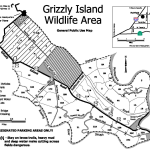
Grizzly Island Wildlife Area is just outside of the Suisun City limits down Grizzly Island Road, with scenic views to enjoy along the way. Along the meandering road, you will drive over an overpass and then past Rush Ranch (I used to run races there and had no idea about the wildlife down the road). Keep going until you reach the Wildlife Area Headquarters Office.
When you get to the office, be sure to sign in and check in. I definitely recommend grabbing a map and brochure. The office is very friendly and can answer any questions that you may have about the area, such as their hours (Monday through Friday, 7 a.m. to 4 p.m.). According to their website, facilities available include: access roads, self-guided tours, parking areas, restrooms, public phone, maps and literature. Disabled access is also available for nature viewing, angling, and waterfowl hunting.
Something important to take note of is that, although the Grizzly Island gets many visitors and is owned by the State, the Wildlife Area is not a park, and so you will not find any park benches, streetlights (note: the area closes at sunset), grills, or campgrounds. Protected by the State and managed by the Department of Fish and Game, it is a wildlife area that is part of the Suisun Marsh—which is about, “84,000 acres of land, bays, and slough,” said Jeanne Clark, who wrote an article about Grizzly Island’s history in the 1989 January/February issue of Outdoor California Magazine.
Surrounded by water, namely Grizzly Bay that runs into Suisun Bay in the south, Grizzly Island truly is an island. In fact, it is actually multiple islands, and totals 12,900 acres of marshland. However, one question that many people, including myself, have is “Did Grizzly bears actually live on Grizzly Island?”
The answer is yes. Grizzlies used to roam all around the state before they became officially extinct from California in 1914. According to Barry Eberling’s article, titled “Grisly Indeed, Grizzly Island was Aptly Named,” grizzly bears would come to the island from Mount Diablo to feed on rose hips and blackberries. They would swim across Suisun Bay to get to the island!
Swimming around the marsh today are river otters, beavers, ducks, fish, and many other animals. I asked the office about the wildlife, and I found out that—even though it is summer—there are a lot of baby animals in the complex. Who would not want to see a playful baby otter? If you want to see the otters, look in “the ditches or sloughs,” Clark said.
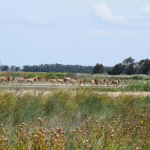
I also learned that the island has tule elk, which many people apparently do not know about. While their population is at its greatest in the fall, you could still see them in the summer. They typically come out in herds when it is cool and quiet, so near the early morning and late day. You may even see some white-spotted calves.
If you are going there to bird or nature watch, bring binoculars to enhance the experience. The complex also has plenty of great things to take pictures of, so bring your smart phone. If you have a nice camera, that is even better.
Grizzly Island is known to have “at least 220 distinct bird species, including 25 waterfowl species, have been identified,” according to the Suisun Marsh Natural History Association, a non-profit dedicated to preserving the space. For bird watching, some of the birds of prey that hunt the marshlands are the prairie falcon, black-shouldered hawk, red-tailed hawk, or short-eared owl. They have plenty to eat in this giant ecosystem. When I went, I saw two American robins, singing up in the sign-in room (identified by their red bellies and long black tails—and by checking suisunwildlife.org).
The wildlife are fun to search for and look at, but it is very important to leave them be (i.e., no touching or capturing without permission unless you are a licensed hunter during their hunting season). Grizzly Island Wildlife Area’s mission statement is as follows: “The mission of the Department of Fish and Wildlife is to manage California’s diverse fish, wildlife, and plant resources, and the habitats upon which they depend, for their ecological values and for their use and enjoyment by the public.”
Grizzly Island is also a great spot to fish at the Montezuma Slough and in ditches and inland waters, permitted in February through July and October through January. Some notable fish that are around include king salmon, catfish, green sturgeon, white sturgeon, and striped bass.
Boating gives access to other fishing areas and tidal sloughs. “Boats [like kayaks] and canoes drift easily on the tidal sloughs,” the Grizzly Island website says. If you plan to boat, you can launch from the parking lots next to the sloughs.
For the hunters or aspiring hunters out there, Grizzly Island allows hunting—mostly during the fall and winter—of waterfowl, pheasant, dove, and rabbit without reservation, though check the regulations on their website. A special permit is required to hunt the tule elk. However, please do not use lead bullets since animals like ducks can ingest them. Since 1991, it has been illegal to hunt for migratory waterfowl with lead bullets, and, “in 2013, California passed the first statewide phase-out of lead ammunition for all forms of hunting,” according to the Humane Society of the United States.
The Grizzly Island Wildlife Area is currently open weekdays, Monday through Friday, from 7 a.m. to 4 p.m. Visit at 2548 Grizzly Island Rd., Suisun City, CA 94585. For additional information, call the Department of Fish and Game at (707) 425-3828 and go to the Grizzly Island website at wildlife.ca.gov/Lands/Places-to-Visit/Grizzly-Island-WA. If you want to learn more about the wildlife living at Grizzly Island, go to suisunwildlife.org/grizzly. Check out the Humane Society’s page at humanesociety.org.
-
-

-

-
Shirley ArringtonCDFW3
-

-
Shirley Arrington CDFW2
-

-
Orlando Rocha1 CDFW
-
-
Larry Wycoff CDFW
 James Quinn lives in Benicia and teaches at Elmer Cave Language Academy in Vallejo. A UC Davis alumnus in English, he now studies education as part of Touro University’s Master’s in Education program. Along with teaching, he tutors and writes often. He is working on a novel that takes place in Benicia. See his website at mrquinnj.weebly.com.

Consider some personal training with fitness expert April Powell
So you’ve got your custom car, your custom house, custom-tailored clothing … or not! What about a custom body? That’s something we’re all capable of working towards, or so we tell ourselves. Going to the gym on our own accord can be seemingly impossible at times. If you’ve made the gym effort to no avail time and time again—and you earnestly want to develop your habits into a more active and healthy lifestyle—learn to sculpt your body inside and out via some one-on-one training with April Powell, owner and operator of Body By Design2 in Vallejo.
April’s motto is simple: “I try to take people from where they are, to where they want to be.” Personal training is the flagship service at Body By Design2. Available by appointment only, she is the one-stop shop for all your health needs. In addition to personal training, she offers small group classes, customized diet plans, customized detox plans, and colon hydrotherapy services. Whatever your case may be, April can and will adapt for your own personal needs.
“Everybody is so different,” she says. “I have people come in, we do an evaluation, and just go at their own pace.” April has some clients recovering from injuries or surgeries who need special localized training in order to get back to their full potential, while other clients can be pushed to the max, as they’ve been training with her for years. If you think that you might not fit the bill on the type of client whom she is looking for—think again. The hardest part is just making that first appointment.
“Until people start, they’re not going to know how good they’ll feel and the real benefit of what it’s doing for the bodies,” April explains. “There’s no feeling inadequate. You don’t have to come in here in top shape, or knowing anything! I’m going to walk you through the process.”
If you’ve yet to figure out an appropriate health regime on your own, you won’t know if someone like April can help you unless you try! And not just a session here and there. You’ve got to give it a solid few months of real effort to really know if it’s for you. “After that, if it’s not for you, it’s not for you,” she says. “But in that time, your body, your mental state, your energy—all of those things will definitely be improved.”
Body By Design2 is, lo and behold, the second Body By Design business April has operated. It first began in 1998 and lasted until 2006 when she officially retired. April’s loyal clients ultimately brought her back in. “I kept getting requests to train individuals, and I didn’t have a location,” she says. “So when I would go to other gyms, I kept getting kicked out because they knew who I was and assumed I was there to recruit. So I found this location, had to gut it, remodel it, and now it’s home.”
Upon entering, you’ll immediately feel at home as well, as April has put her personal touch on everything to make people feel welcome since opening up again in 2014. “Whoever walks through the door, male or female, I try and make it very comfortable for people,” she says. “It has a big spiritual side to it, a relaxing side, and it has a ‘let’s get in there and get it done!’ side.”
Since adding the service two years ago, April has found there to be quite a large demand for colon hydrotherapy. “I’m really surprised at the response and the need for it,” she says. “It’s quickly becoming just as important as the personal training.” We asked her what type of person would need colon hydrotherapy, to which she responded: Everyone. “Everyone who is trying to lose weight, trying to get healthy, who’s doing a cleanse, who’s athletic, especially those in the gym taking lots of supplements and synthetics—the more you can cleanse your large intestines, the better your body is able to function.” Even if you have breakouts, trouble sleeping, irritable bowel syndrome (IBS), eczema, even cancer, she recommends colon hydrotherapy. “If you have any type of medical condition that is causing some sort of constipation, some sort of upset stomach … it’s good for everyone.”
Whatever your needs may be, April will accommodate. All you’ve got to do is meet her halfway. “We really emphasize the benefit of people just not giving up on themselves,” she says. “If it didn’t work in the past, that doesn’t mean that it’s not going to work now!” She explains how you really just have to get with the right person who can guide you and help keep you motivated, and reminds us that it’s a team effort. “I can’t do it by myself. But if we do it together, we can get it done,” she says. “You have to take the first step and call, and show up, and do what I tell you to do, and you’ll get the results that you’re looking for.”
Feeling motivated? Feeling pumped up? No? Well then, you definitely need to give April a call. You can reach her at (707) 853-5239, email her at 2bodybydesign@gmail.com, or visit www.bodybydesign2.com. If you don’t do it right this very moment you’ll probably talk yourself out of it, so quick! Before it’s too late! Make the call, send the email, and start truly designing that body of yours.
 Matt Larson is an actor/comedian/director from Vallejo who lives a double life between the Bay and LA. When he’s not writing for Local Happenings Magazine he could be editing a short film or working on his next rap album—who knows!
Keep up with all things Larson at MarsLegstrong.com.

Here’s what’s happening at the Calistoga Speedway
If you’re looking for an adrenaline rush and want all of the thrills without any of the danger, come live vicariously through some of the racers over at Calistoga Speedway in the glorious Napa Valley. Hopefully, the fact that the wine country has such a venue doesn’t surprise you, as they’ve been keeping the racing tradition strong there in Calistoga since 1937. Located at the Napa County Fairgrounds, events this year at the half-mile dirt track have included monster trucks, winged sprint cars, and flat track motorcycle races, to name a few.
There’s not a ton of events here, so you really have to plan ahead to make sure that you don’t miss some of these rare opportunities. They only do maybe five special events per year—some multi-day events—but they definitely focus on quality over quantity.
“All of the events we do involve touring series,” said Tommy Hunt, promoter for Calistoga Speedway. “So they’re events that people would not normally get an opportunity to see in the area.” And if high-speed racing at 120+ mph wasn’t enough of a draw in itself, this is Napa Valley after all! Coming to an event here at the Calistoga Speedway, you can expect that they leave no stone unturned—wine, beer, bands, food… the best of the best, naturally. You’re bound to find something that you like.
Keeping up with the community, recently an event at the speedway led to a massive donation to the local Boys & Girls Clubs. On June 24th of this year, fans gathered ‘round to attend the Calistoga Speedway Boys & Girls Clubs of St. Helena & Calistoga Dirt Classic 2017, which featured famed drivers like Rico Abreu, Tony Stewart, and others who raced winged 360 and 410 sprint cars around the track. Good times were had by all, and to top it all off, two checks were presented to the Boys & Girls Clubs of St. Helena & Calistoga: one for $100,000, donated by Staglin Family Vineyards and another for $150,000, which was a combined donation from the race industry and individuals throughout the country—totaling a quarter-million dollars.
That event is a great example of what these racing events at the Calistoga Speedway have done for the local community, and it is also a prime example of the kind of talent that can be found here at these adrenaline-pumping exhibitions. Among many achievements, Rico Abreu won the 2014 USAC Midget National Championship, Tony Stewart has three NASCAR series championships to his name, and also in attendance was recent Monster Energy NASCAR Cup Series winner Ricky Stenhouse, Jr.
Rico’s father, David Abreu, is actually a third-generation rancher from St. Helena and founder of Abreu Vineyards, which is a major sponsor of the Calistoga Speedway. “David Abreu has been a huge contributor to the fairgrounds, in reference to what he has supplied,” said Hunt, who has seen some awesome developments thanks to Abreu over the last 10 years. “A catch fence has been installed, completely encircling the racetrack which makes it far safer; a theater-type sound system has been installed, scoreboards have been installed, the racetrack has been graded and prepared in a very professional fashion, not to speak of the prep work that he does prior to the races to make the racetrack clean.”
It’s thanks to contributors like Abreu that the speedway can function the way it does. “This is a labor of love,” Hunt explained. “With the cost of the facility and the cost of producing one of these events, it’s very difficult to make money.”
One of the biggest events of the year at Calistoga Speedway is the 10th Annual Louie Vermeil Classic, held this September 1st, 2nd, and 3rd. The event begins on Friday, September 1st with the Calistoga Speedway’s annual Hall of Fame Dinner. It usually hosts about 400 guests, who will enjoy a catered evening out as they watch the new hall of fame inductees. The inductees have been carefully selected based on their contributions to the races either as the performance drivers out on the track or as individuals behind the scenes who help keep the tradition alive. Then, on September 2nd and 3rd, thousands of attendees will gather to see the USAC/CRA non-wing, traditional “410” sprint cars and Midgets from Southern California meet with their Northern California rivals, as well as National USAC drivers.
Many of the famed racers who made their name in Calistoga are often in attendance, such as LeRoy Van Conett, Mike Andreetta, Johnny Anderson, and also Dick Vermeil. Most probably know Dick Vermeil as the head coach of the St. Louis Rams when they won Super Bowl XXXIV; however, here in Calistoga, he’s the son Louie Vermeil, the namesake of Calistoga Speedway’s main event.
Calistogan Louie Vermeil was the owner of Owl Garage on Washington Street. When the popularity of automobile racing truly caught on after World War II, it was Vermeil who took the reigns here at Calistoga Speedway that led it to what it is today. “He was the one that basically came in and organized races at Calistoga,” said Hunt. “He did that as part of the Northern Auto Racing Club, but Louie was the driving force.” By 1960, Vermeil was actively boosting the professionalism of sprint car racing. For the next 25 years, while Vermeil presided as president, Calistoga Speedway was known as the “home” of the Northern Auto Racing Club, which is now known as the Golden State Challenge Series. That’s why today the Calistoga Speedway is also referred to as the “Home of Louie Vermeil.” In fact, the house that Louie lived in became a historical monument.
Back in Vermeil’s day, admission price for the races was around 55 cents. While it’s not quite in the same ballpark today, attending the Louie Vermeil Classic is still pretty affordable, and rest assured it will be worth every penny. Reserved seating is only $35, general admission is $30, kids 6-12 are at $10 per ticket, and kids 5 and under get in free. The Hall of Fame Dinner is $55, pre-sale only, and last year’s event was sold out; so if you want to get in on the action, it’s best to do so now. To get your tickets, call HMC Promotions at (916) 773-7225. Especially, if you’ve never been to an event at the Speedway, the Louie Vermeil Classic would be a great introduction.
As this year marks the 10th anniversary of the Classic, they definitely have some special surprises in store, but at this writing it’s too early to tell exactly what to expect. What we can tell you is that they’ll have something for everybody. Live music, vendors, merchandise for sale, wine, beer, and high-speed racing.
“Racing here may be as good as there is anywhere in the country, on a half-mile dirt track, specifically,” said Hunt. “It’s first-class entertainment. The atmosphere is great at these events. And, of course, the area lends itself to being a great place to be—I don’t know that there’s a lot of places more beautiful than the Napa Valley in Calistoga.”
By the time you read this, you have probably just missed the AMA flat track motorcycle races on July 29th. If you can’t make it to the Louie Vermeil Classic, try and make it to the World of Outlaws sprint car races on September 15th and 16th, which are their last race events of the year. For additional information, visit calistogaspeedway.org. Search for “Calistoga Speedway” on Facebook, or call the promotions line at (916) 773-7225, or directly call the Napa County Fairgrounds at (707) 942-5111.
-

-
photo credit: Steve Lafond
-
-
photo credit: Steve Lafond
-

-
photo credit: Steve Lafond
-

-
photo credit: Steve Lafond
-

-
photo credit: Steve Lafond
-

-
photo credit: Steve Lafond
Matt Larson is an actor/comedian/director from Vallejo who lives a double life between the Bay and LA. When he’s not writing for Local Happenings Magazine he could be editing a short film or working on his next rap album—who knows!
Keep up with all things Larson at MarsLegstrong.com.