
FORAGING
By Chef. K. Marie Paulk
I have always loved the expression “to forage” because I love a good hunt. Did you know truffle season is upon us? To be perfectly honest, I did not. This topic has been challenging since I knew very little about truffles. Sure, I remember quite distinctly when I was in culinary school, and my chef told us when you are working, and a reliable source comes to your back door to buy truffles, do it—don’t miss the opportunity. I now also know why I have never been a fan of truffle fries: it is not the truffles but is most likely the oil. I have a fairly good nose, and let’s face it; we eat with our nose, and if it does not smell good to you, you are most likely not going to enjoy the taste.
Truffle season is from the first of December to the end of January. I have read that if you have ever been to France during the truffle season, you will never forget the smell of truffles.
A truffle is the fruiting body of a fungus, which grows underground. Other mushrooms grow underground, but truffles are the only valuable ones. The plant itself consists of an extensive web of filaments so fine that it is invisible. The filaments, known as mycelium, connect with the roots of certain trees (oaks) and shrubs, which is called a mycorrhizal relationship (benefitting both the plant and the truffle). The trees benefit from the filaments of the truffle when it becomes an extension of their roots, enabling it to draw up more sustenance and minerals from the soil. The truffle gets nourishment from the tree in the form of products synthesized by its leaves. They are organically bound together by a special growth called mycorrhizal. Pretty exciting—I guess this is why these gems can’t grow just anywhere.
Truffles are expensive mushroom relatives, usually cooked very briefly or just warmed to preserve their unique aromas. Truffles, like mushrooms, are fungi that are attracted to the root systems of certain trees. Oak and willow trees produce the most aromatic kinds. The anatomy of a truffle is like a mushroom, but unlike mushrooms, truffles are found underground. The spores are contained in the masses of tissue between the vein-like folds.
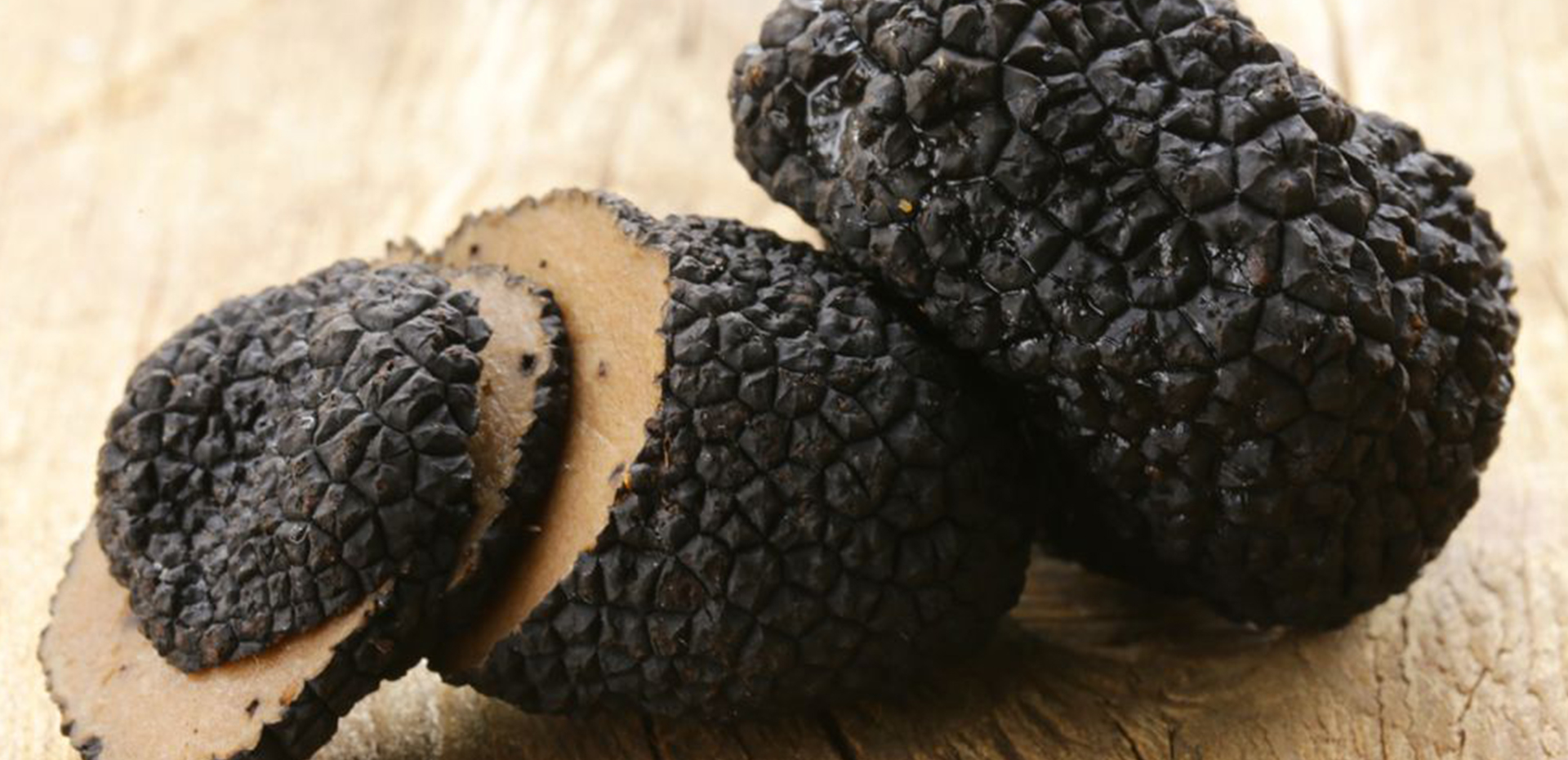
Black truffles smell earthy and have a bumpy black exterior and a dark interior with white veins. They are harvested in the Périgord and Provence regions of France, but you can also find black truffles in Italy, Spain, and Portugal.
Winter truffles have more aroma and flavor than a summer truffle. The summer truffles are tan inside and have a lighter flavor than the winter truffles. The winter truffle has a smoky flavor, making the winter truffles more sought after, which makes them more expensive.
The white truffles are more delicate than the black truffles and have a garlicky smell. Alba, in Italy’s Piedmont region, is where most white truffles are found, but you can also find them in northern Italy. The exterior is beige whereas the interior is pale with creamy veins.
Some species of truffles are grown in North America: a white truffle named the Tuber texense, as well as varieties of truffles that grow wild in the Pacific Northwest.
Skilled hunters (foragers) may be able to detect truffles from signs on the surface that there is one below; however, the guidance of an animal is the best aid to a successful harvest. For instance, a pig or a dog can detect the aroma of a mature truffle, though I have read that trained dogs are easier to work with since a pig could be considered a truffle poacher (i.e., separating the truffle from a dog could be considered less awkward since dogs are less possessive). There is an article in the SF Chronicle that I read about the training of the Italian dog: Lagotto Romagnolo, right here in California.
Use a reputable source when purchasing truffles (i.e., if you are lucky enough to find fresh ones). If you use canned truffles, they will usually only give a suggestion of their original flavor. While there are several truffle species, most are less flavorful than the black winter truffles from France or the white truffles from Italy.
Truffles should be stored in the refrigerator, enclosed in an airtight container. They are very perishable and should be stored with uncooked rice to absorb moisture and keep the surface of the truffle from getting wet, which would make it spoil. Also, consider investing in a truffle shaver to shave larger, thinner pieces. If you used a plain grater, the aroma of the truffle would dissipate into the air. Some truffle oils will be strengthened by artificial flavors that can be overwhelming. Remember the truffle fries?
Like with wine, there are good years and bad years for truffle harvesting. Truffles are typically used as a garnish, but they may also be served as a vegetable (which would be costly) or an hors d’oeuvres. When served, they should be served simply, since they are considered by some to be already perfect.
Happy Hunting!