[weaver_extra_menu menu=’featuresMenu’ style=’menu-horizontal’ width=’100%’ css=’menu-horizontal’]
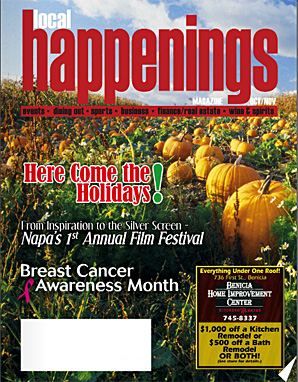
From Inspiration to the Silver Screen: The Napa Valley Film Festival
It is the dream of every kid with a video camera that someone other than his parents will see and be enthusiastic about the end result of hours of conception, crafted filming and wise editing choices coming together as a film that might even be considered a work of art.
For five days, November 9-13, 2011, many will get that chance when the inaugural Napa Valley Film Festival kicks off in a bid to deepen the cultural significance of an area already famous worldwide for its dining scene and viticulture.
Film industry veterans, Marc and Brenda Lhormer, have culled together their experience of helming the Sonoma Valley Film Festival for 7 years (2002-2008) to develop an event on a grander scale and appropriate to the attributes Napa continually prides itself on. “The Napa Valley Film Festival will be something for residents to embrace and be proud of,” Co-Founder and Events Director Brenda Lhormer says. “It will be an event to show that Napa is a great place to live.”
Film festivals, which have traditionally been where artists, producers, directors and actors gather to share their latest efforts, talk shop and sow the seeds for future endeavors, have existed since the early era of moving pictures. Other than being related to someone famous in the film industry, the best way for filmmakers to get their work seen is by submitting their works to festivals.
The origins of the Napa Valley Film Festival began back in 2005. Downtown Napa was still in the early stages of its redevelopment when the Napa Valley Chamber of Commerce approached the Lhormers to discuss the logistics of staging a festival in Napa. “They wanted a new cultural event to show off the new downtown,” Lhormer says.
The Lhormers were keen on the idea and gave a presentation. The Chamber showed immense interest, but the couple had their own projects in the works and were still invested in the Sonoma Valley Film Festival.
During their experience producing the 2008 film Bottle Shock, which debuted at the Sundance Film Festival, about Chateau Montelena and the rise of Napa Valley wine on the international level following the 1976 Judgment of Paris, Lhormer and her husband decided they wanted to expand their vision of what a film festival could be.
They approached the Board of the Sonoma Valley Film Festival offering to put on an event in Napa during the fall that would complement their event in the spring (which has traditionally taken place for the past 14 years). “Unfortunately, our vision wasn’t shared by the Board.”
The couple decided to pursue an independent festival in Napa for the fall on their own and contacted the Napa Valley Chamber of Commerce, who made it clear that they were still interested. The Lhormers then reached out to local businesses and wineries to see if the community would rally support behind the festival as well.
Last year, the couple decided to have an audition for the festival by showing several films in downtown Napa, including Oscar winner The King’s Speech, as a “proof of concept”. Having spent the previous two years developing support and planning the festival, the trial run went better than hoped. “It was really successful,” Lhormer says. “It was sort of like year zero of the Napa Valley Film Festival. People could see what we were trying to do.”
To further advance word of the festival, the Lhormers took 17 Napa winemakers to this year’s Sundance, along with restaurateur Michael Chiarello.
Once the concept was finalized and the support system established, the Lhormers got to work. “Almost everything I learned during the Sonoma Valley Film Festival, I’ve put in place in Napa,” Lhormer says.
After assembling a team, they started building the festival from their years of previous experience. “We got our training in Sonoma,” Lhormer says. “We got to experience what could go wrong. So this time we were prepared and things are going well.” Problems like last minute commitments by filmmakers, and where to lodge them, were among the headaches for which the festival staff was already prepared.
The inaugural festival will present 90 films over five days up and down the Napa Valley. The communities of Napa, Yountville, St. Helena and Calistoga will each operate an independent “walkable festival village”. The majority of films will be shown in each village, so local residents will not have to travel far to participate.
Among the 35 venues that make up these villages there will be four basic types: theaters for the films themselves, a welcome center with guides and general information, local wineries will be pouring at wine pavilions throughout the festivities and, finally, there will also be a VIP Lounge for patrons, filmmakers and media guests where they can meet, mingle and relax in a hospitable setting.
The top prize will be awarded in the U.S. Narrative Feature Category, which will showcase 10 films and the winner receiving $10,000 from Meadowood Resort and Spa. Directors from this category have also been invited to participate in the Artists-in-Residence program (also hosted by Meadowood). The filmmakers will meet with influential members of the industry in a mentorship role to discuss guidance, future projects and offer inspiration to those at the beginning of their careers.
This year’s films will be representing countries as diverse as Denmark (Rosa Morena), Australia (Face to Face), Sweden (Among Us), Mexico (The Tinyest Place), Romania (Tilt) and Argentina (The Ways of Wine). The last feature, The Ways of Wine, will be shown by the star, a sommelier discovering his pallet through wines from his native land.
Other films of note include: White Knights, starring Tom Sizemore; Jiro Dreams of Sushi, a documentary about the most famous sushi chef in the world; Kumare, a film about a man who convinces the faithful that he is a spiritual guru; The Other F Word, a documentary about famous punk rockers who are now fathers; the world premiere of Ctl+Alt+Compete, a documentary focusing on technology startup scene; the world premiere of Warren Ellis: Captured Ghosts, a documentary about the graphic novelist; and, Like Crazy, which was a recent hit and top dramatic prize-winner at Sundance.
The biggest film to play at the Napa Valley Film Festival, however, will be the latest effort by legendary actor, filmmaker and Bay Area native, Clint Eastwood, about the life of the infamous director of the FBI, J. Edgar Hoover, J. Edgar, starring Leonardo DiCaprio, which will be shown on Thursday night (November 10th).
Another point of pride for local Napa residents is the utilization of the venue once known as the COPIA Center for screenings in the 260-seat theater, one of five festival welcome centers in downtown Napa. “We are certainly proud to be at COPIA,” Lhormer says.
Other venues presenting films will be the Napa Valley Opera House, Bottega Ristorante, Barrel Room 1870 in Yountville, Jarvis Conservatory and Hatt Hall in the Napa River Inn – included to be an intimate location (to be known as The Lounge) reserved for a series of films aimed at an audience appreciative of edgier, more adventurous themes. “We knew that we would have to have films that will appeal to everyone,” says Lhormer. The films at The Lounge “will definitely appeal to younger people.”
The Napa Valley Film Festival will also hold panel discussions on relevant filmmaking topics. Panels will cover music and movies, screenwriting, behind the scenes with actors, critics, a pitch session where anyone in attendance is allowed 60 seconds to pitch a movie or television idea to a group of producers and filmmakers and pop-up panels (called the Tweethouse) where filmmakers and the public can discuss “how technology is affecting film,” according to Lhormer.
Access to the festival is open to anyone interested in film. There are multiple levels of passes available to the public. Individual showings, called Rush tickets, are offered at $10 to $20 per ticket at the main door of the venue immediately before the film. Day passes are also available. Napa and Sonoma County residents can receive a discount on passes on the website, so be sure to tell your friends. If you prefer the VIP treatment and all its perks, you might opt for a Patron Pass. When you become a Patron, you will gain access to special showings, including the Sneak Preview Night, the Opening Gala, priority seating at all events, complimentary refreshments from many of the valley’s finest restaurants and wineries, and entrance into the same VIP lounges that the filmmakers and actors will visit. It should be said that there are tiers to the Patron Pass, with ascending exclusivity for an added price.
Film can change how we view the world – or ourselves. Often, it is projects like those without major studio financing that enrich one’s life most deeply. The Napa Valley Film Festival hopes to be a conduit for such films to find a wider, appreciative audience.
For more information or tickets please go to their website: napavalleyfilmfest.org.

By James Hritz – James grew up in the Wine Country, but has written for various publications across the country. He is happy to be writing and working in his home again.
Rocktoberfest
Strudel? Perhaps. Sauerkraut? Definitely. Schuhplattler? Well, that’s a new one for Vallejo. If you’re curious as to just what exactly schuhplattler is, or holzhackertanz or vorplattler, such mysteries will be revealed at Vallejo Rotary’s first annual Vallejo Rocktoberfest this October 21st (they’ll also be revealed in a few paragraphs). All the standard Oktoberfest amenities will be in place at Vallejo Rotary’s new event, but the Vallejo Rocktoberfest offers much more than just beer and bratwurst … it’s bringing lederhosen and rock n’ roll.
However, first things first: the beer. The all you can drink beer, mind you. With your ticket purchase you can drink as much as you like, though we don’t suggest you go for a record. For true Oktoberfest enthusiasts, look forward to some authentic German ale and seasonal brews provided by both the Blue Frog Grog & Grill and Napa Smith Brewery. Round Table Pizza will also be providing standard domestic beers in an effort to satisfy Rocktoberfest goers of all kinds. Wine will be available as well, however, “We’re promoting the beer. It’s Oktoberfest,” says Jeanne Kilkenny-Turk, president of Vallejo Rotary. Past president and event chairman Constance Howard agrees. “Beer and more beer. And music,” she says. “How could that not be fun?”
As to not get too tipsy, there will be plenty of food available to help balance out your alcohol intake, care of Catering By Ray Martin, who has been serving our Napa-Solano friends and neighbors for the past 15 years. Food options include both German and American sausages, sauerkraut, hot and cold potato salad and apple strudel. The best part of all, as with the beer, food is all you can eat! All you can eat, all you can drink, you may want to start practicing mass consumption habits now.
The true authenticity of the night will be brought to you by the Golden Gate Bavarian Club, a schuhplattler, or “shoe slapping,” group that brings traditional Bavarian culture with them wherever they perform. “There’s about 40 or 50 groups like us all across North America,” says Fritz Sheffler, vorplattler (German for “head dancer”) of the Golden Gate Bavarian Club. “Basically, these groups are formed by people who have Germanic heritage, mostly Bavarian, and want to celebrate their culture. They do the dances, learn to play the instruments, speak German … it’s a cultural thing and performing is a way of sharing that with people.”
At about 20 members strong, the Golden Gate Bavarian Club brings anywhere from four to 12 members with them to a performance. Full of traditional dances and some interactive games, the Bavarian Club puts on quite a show. “Sometimes we throw in a woodchopper dance (holzhackertanz), or maypole, teach polka, whatever people want to learn. We’re basically there to dance, have fun and share some of the Bavarian tradition,” says Sheffler. “A lot of people like to see these traditional dances; you won’t see them anywhere else besides when we perform, and if you happen to go to Bavaria.”
Were it just the Golden Gate Bavarian Club providing the entertainment this would be a slightly different event, but it is the Vallejo ROCKtoberfest, and adding that rock flare is local band Lucas Ohio and the Shamblers. “We have a rock and roll band just to give it a different flavor,” says Kilkenny-Turk. “The goal is to bring people out in Vallejo and have a good time.”
Now, for those who don’t know, Rotary is an internationally recognized service club comprised of business and civic leaders. They meet once a week, committing to their motto “Service Above Self”. Vallejo Rotary was first chartered in November of 1921, soon to celebrate their 90th anniversary of community service this year.
Vallejo Rotary has a number of community projects in the works, but the primary directive for funds produced from Vallejo Rocktoberfest will go toward Dan Foley Park’s renovation area. “We’re looking to build another children’s playground out there but it might take us a year and a half to raise the money for it,” says Kilkenny-Turk. “I’m hoping that Rocktoberfest is successful, it depends on how much money we raise.” Representatives from the Greater Vallejo Recreation District will bring displays to Rocktoberfest with the plans for Dan Foley Park. And, while the Dan Foley Park renovation is the main focus of fundraising at this event, it isn’t the only place the money will be going.
“We will be delivering dictionaries in November to every third grade student in the city of Vallejo,” says Kilkenny-Turk, the dictionaries being funded directly from Vallejo’s annual Ducky Derby in association with Vallejo Rotary and the Vallejo Chamber of Commerce. Kilkenny-Turk adds, “We give out over $10,000 in scholarships every year to high school students. We also send seven children, yearly, to a leadership camp called Camp Royal.” These are all things that Vallejo Rotary does for the community every year, in addition to other endeavors such as sponsoring projects at Loma Vista Farms and Children’s Wonderland, sending students to Camp Venture at the California Maritime Academy, co-sponsoring Fishing in the City to teach elementary schoolchildren how to fish … the list goes on … and fundraisers such as Vallejo Rocktoberfest are essential to Vallejo Rotary’s success in the community.
Vallejo Rotary hasn’t had a fundraiser such as this in some time now – some may remember their Texas Hold’em tournament a few years back – but a Rocktoberfest is certainly a big change from previous events. “We’ve never done anything like this, it’s a completely new thing for us,” says Kilkenny-Turk. “My goal is to get people out for something to do in Vallejo, and at the same time it’s going to a good cause.”
Kilkenny-Turk had been thinking about putting on a big fundraiser for Vallejo Rotary long before she took over the presidency last July. She realized that there’s usually not a whole lot going on in the fall months, it’s after everyone’s yearly golf tournaments and before all the service clubs’ crab feeds. “It’s a different time of year to get people out,” she says. “I’ve gone to a few Oktoberfests and thought it would be a fun thing to do.”
The event will be held at one of Vallejo’s nicest venues, with one of the nicest views: the Springbrook Masonic Temple. “It’s one of Vallejo’s hidden jewels,” Howard says. The weather is supposed to be just right and with a grand patio outside of the temple’s banquet room, Kilkenny-Turk adds, “The view out there is going to be beautiful.” She plans to coax the guests outside if even for a little bit to enjoy the view. “We’re getting the beer wagon from the Wednesday Night Celebration so that will be parked outside.”
While Vallejo Rocktoberfest is an event sponsored by Vallejo Rotary, Kilkenny-Turk cannot stress enough that the event is open to the general public and anyone, ages 21 and up, is welcome to attend. “Everybody’s invited to the event,” she says. “Rotary is sponsoring this event for the community to come out and have fun; you don’t have to be a member of Rotary to come. We want non-Rotarians to come out.”
There are sponsorships available for those to want to make sure that Vallejo Rocktoberfest is a successful event and can adequately support Vallejo Rotary’s community projects. A $300 sponsorship gets two tickets, recognition at the event, leading up to the event, and after the event on all promotional materials including their website, Facebook, newspaper ads – everything. A $150 sponsorship gets a ticket to the event, recognition the night of and on promotional materials after the event, but not before.
This fundraiser could certainly become a new staple event for Vallejo. The Masonic Temple can fit a few hundred guests, “We’re hoping to pack the place,” says Kilkenny-Turk. “I’m truly hoping that if we have a successful year this year, we can continue on. It would be something that we can definitely do as an annual thing.” And above all else, Kilkenny-Turk looks most forward to just having a community event: “Getting people out there to come together, have a beer and some brats and enjoy the fall season.”
Tickets to the event are either $55 per person, or $100 per couple. Your ticket includes all you can eat food and drink and beer and more beer, as well as a commemorative beer mug! … Did we mention the beer? Sodas and water will also be available, as well as door prizes and a raffle. So start planning now for what is sure to be the first of many epic Rocktoberfests in the city of Vallejo. Invite your friends, come hungry and thirsty, and you may want to consider transportation arrangements. Drink responsibly!
For more information go to: www.vallejorocktoberfest.com
By Matt Larson: Matt Larson is not just a writer, he does lots of other stuff with his time. Example? Sure! He hosts stand-up comedy shows and would like YOU to attend on October 22, 2011 at the Fetterley Playhouse in Vallejo! Info @ www.thecomedycircuit.com.
Breast Cancer Survival Starts with Screening
Fatalities from breast cancer have been decreasing in the U.S. since 1990, thanks primarily to earlier detection and treatment advances. But it still ranks second – behind lung cancer – for the leading cancer deaths in women. According to breastcancer.org, 12 percent of American women, about one in eight, will develop invasive breast cancer over the course of their lives.
The Statistics
More than one in four cancers diagnosed in U.S. women (28 percent) are breast cancer, second only to skin cancer. Caucasian and African American women have a higher risk of developing and dying from breast cancer than women who are Asian, Hispanic or Native American. Caucasians are slightly more likely than African Americans to develop breast cancer, but they’re less likely to die from it, as tumors in African American women tend to be more aggressive.
Genetics do matter when it comes to breast cancer; a woman’s risk approximately doubles if she has a first-degree relative (mother, sister or daughter) who’s been diagnosed. 20 to 30 percent of women who’ve received a breast cancer diagnosis have a family history of it, however, those without a genetic link shouldn’t consider themselves “safe.”
The overwhelming majority of those who develop breast cancer (70 to 80 percent) don’t have any family history. The biggest risk factors for developing breast cancers are two things over which women have no control: their gender and age.
Now here’s some good news. As of 2010, there are more than 2.5 million breast cancer survivors in the United States. Medical researchers are working hard to ensure that number continues to go up, but women themselves play an important role in determining their fate given the critical importance of being diagnosed early.
Screening and Detection
Breast self-exam is something women can begin in their 20s and continue on a monthly basis throughout their lives. It’s important for each woman to become familiar with her anatomy, to be able to tell if something has changed from month to month. It’s very common to feel masses that are benign, such as cysts. While it’s a good idea to get any mass examined, cancer is usually the least likely outcome, occurring just five percent of the time.
It’s also a good idea to perform self-exams right after menstruating each month, as that’s when the breast is least lumpy. If something doesn’t feel right, most physicians would rather have you come in and let us tell you what’s going on, then wait until your annual physical or mammogram. If it’s nothing, that’s great, but if we suspect something’s awry, we may want you to get an ultrasound (if you’re under 30), get a mammogram or undergo a needle aspiration. If we’re in doubt about whether further action is necessitated, we’ll refer you to a specialist for further testing.
Mammograms are the best breast cancer diagnostic tool we have because they can detect tumors as small as one-half to one centimeter. It’s recommended that all women begin annual screening at age 40, and those at higher risk should start a decade sooner, using other diagnostic imaging if necessary.
Women at high risk include those with a strong family history of breast cancer (in a first-degree relative) as well as anyone who’s undergone genetic testing and learned she has a BRCA gene mutation. Women taking hormones, even at low doses, have also been found to have a significantly higher risk of breast cancer, and their tumors tend to be more aggressive.
While it’s not possible to change your age, gender or genetic makeup, there are things you can do to lessen your chance of getting breast cancer. For instance, eating a healthy, low-fat diet and exercising are recommended.
Treatment and Survival
Like all cancers, treatment for breast cancer at earlier stages is more likely to be successful; 88 to 90 percent of women diagnosed early will survive for 10 years or longer. Each course of treatment will be different and is dependent on factors like age, cancer grade, lymph node involvement and receptor (hormone) status.
Breast cancers diagnosed at stages 1 or 2, when the tumors are less than five centimeters, are typically treated by a lumpectomy (surgical removal of the tumor) followed with a course of radiation. Lymph nodes in the armpit are also tested to see if the cancer has spread, a procedure that used to be quite invasive but has become less so over the past five years.
What always must be kept in mind when dealing with breast cancer is that long-term survival is based on preventing the cancer from metastasizing to the bones, liver, brain or other organs. As a result, in women diagnosed with advanced breast cancer, as well as those who don’t want a lumpectomy and radiation or have previously had a lumpectomy, a mastectomy is typically recommended, followed by chemotherapy – typically for four to eight treatments, every two or three weeks – to treat any cancer cells that escaped from the original tumor.
Since a mastectomy can be emotionally devastating, it’s important for women to have a strong support structure that includes family and friends, as well as their medical team. We find some women desire a mastectomy due to the shock of a recent cancer diagnosis, so we offer counseling, education and support groups to eliminate irrational decisions and ensure they’re comfortable with their treatment choices.
Some women decide to have a mastectomy for precautionary reasons due to a history of questionable mammograms following a lumpectomy. In these cases, reconstructive surgery is always an option, although many older women choose not to pursue it.
In addition to focusing on regular screening, the medical community is working hard to test individual cancers so we can better pinpoint specific courses of treatment; for example, in certain cases it’s possible to test the tumor to help determine who is best suited for chemotherapy. Research is ongoing to maintain the downward trend in breast cancer fatalities.
 By Robert Lanflisi, M.D. – Dr. Lanflisi is a board-certified surgeon who concentrates on cancer surgery. He’s affiliated with Sutter Solano Medical Center and is a member of Sutter Medical Group’s Community Provider Network.
Take a Hike
When one thinks of exercise in modern context, often the images that come to mind is a woman running on the treadmill who appears to be in perfect shape, a man lifting free weights while watching himself in the mirror or a group doing a yoga or spin class. All this imagery that ignites in one’s mind at the very mention of exercise usually takes place in the comfort of a gym. Although these so happen to be the images that appear, they do not have to be what works for you. What people may not realize is that there are numerous ways to exercise outdoors while taking advantage of the beautiful scenery and hiking trails around them. Going to these places and attending events held therein is a fantastic way to change up your work-out to maximize results while at the same time enjoying the environment and the people around you and, in the case of some events, helping out a worthy cause.
The City of Lafayette Chamber of Commerce does just this by holding an annual event that gives a portion of the proceeds to its local schools. The Lafayette Reservoir Run is a series of races that take place in Lafayette each year on a day in late October. Races include a 2-mile “Run for Fun”, a 5K and a 10K. Each participant has the opportunity to choose which school they would like 10 percent of their entry fee to go toward. There is an estimated 2200-2500 participants each year. That can really add up and make a difference for the schools in Lafayette. A portion of the proceeds also go to the Lafayette Chamber of Commerce to continue this program and to preserve the reservoir. The Lafayette Chamber of Commerce credits the event as being an extremely popular “family affair” in which parents, grandparents and children come to both witness and participate in the event together, perhaps bridging the generational gap among Lafayette citizens. This year marks the 19th year this event has taken place and, with continued enthusiasm, it certainly will not be the last.
According to The Lafayette Chamber of Commerce website, “the 925-acre site with a 1.4 billion gallon reservoir was opened to public recreation in 1966 with hiking, fishing, boating and picnicking.” Therefore, if running is not your sport, the reservoir can provide you with worthy activities year round to support an active and healthy lifestyle. Bikes, roller blades, roller skates and scooters can be utilized in the recreation area as well, however no skateboards are permitted.
Lafayette is not the only place with a lush landscape to enjoy. There are a myriad of places in the Bay Area that encourage outdoor exercise and activity, as well as preservation of the environment around us. As of 1986, the Solano Land Trust, formally known as the Solano County Farmlands and Open Space Foundation, set out to protect the beautiful landscapes that call Solano County home. According to the Solano Land Trust website, “the mission of Solano Land Trust is to permanently protect and preserve farmland, ranchland and open space in Solano County through the acquisition of land and agricultural conservation easements, education, and land management.” Now, 25 years later, the Solano Land Trust has adhered to its bold mission and to date “has permanently protected 20,041 acres of natural areas and agricultural lands.” Among these lands are Jepson Prairie Preserve, Wilcox Ranch, Rush Ranch, the King-Swett Ranches and the recently acquired Rockville Trails in Fairfield. Each area has its own unique landscape and activities encompassed within.
The 1,556 acre Jepson Prairie Preserve would definitely fall into the category of unique. Categorized as a vernal pool which, according to the Solano Land Trust, are “temporary bodies of water formed when an impermeable layer of soil prevents ground water seepage and traps winter rain in shallow pools,” are particularly rare and are home to endangered species and rare plant life. Among these flora and fauna respectively is the “vernal pool fairy shrimp, Conservancy fairy shrimp, vernal pool tadpole shrimp, and California tiger salamander.” Bogg’s Lake hedge-hyssop, dwarf Downingia, Baker’s navarretia, Colusa grass and Solano grass are among some of 400 various plant species that are distinctive of this vernal pool habitat. There are ongoing tours of the Jepson Prairie Preserve throughout the year and trails are always open for those in need of a good hike.
Another area that is under the protection of the Solano Land Trust is Rush Ranch, located in Suisun City. Acquired in 1987, the ranch is home to marsh and grassland that has been said to please young and old, biologist or painter, photographer or the simple hiker alike. Similar to many of the properties under the protection of the Solano Land Trust, Rush Ranch is unique in that it is home to many unique species. According to the Solano Land Trust website, “approximately 230 different species of birds have been seen throughout the marsh and grassland habitats, and plant communities range from spring wildflowers to native bunchgrass and marsh-adapted vegetation.” Rush Ranch is home to several endangered species as well. With funding from San Francisco Bay National Estuarine Research Reserve and Coastal Conservancy, the Solano Land Trust has invested in a now complete Nature Center, which is meant to “showcase the many natural and historical features of the property.” Rush Ranch is open seven days a week and has ongoing volunteer opportunities and events throughout each month, including “Get the Rush” held on the 3rd Saturday of every month. This event is family focused and offers free activities for all age groups.
Although the Solano Land Trust encompasses a great deal of magnificent property in the Bay Area, the organization does not represent the entirety of diverse properties within our reach. Each town has something to offer, if you know where to look. One such a place, that I have spent a great deal of time hiking at, is a series of trails in Benicia. One such trail connects Benicia
 Sarah Dowling is a Journalism student and a recent graduate from Solano Community College. Growing up in Vallejo, she sets her sights on her Communications B.A. by moving to Rohnert Park to attend Sonoma State University.
[weaver_extra_menu menu=’diningMenu’ style=’menu-horizontal’ width=’100%’ css=’menu-horizontal’]
Food: Party Planning Made Simple
The holiday season is a very special time for my family. We love to share this time with ourselves and close friends, we look forward to enjoying each other’s company during this joyous celebration, and we are lucky in that the entire family loves to participate and make the holidays special. But there are many preparations to think about as well. We take extra time preparing for the special day. For us it is rarely just a dinner – it becomes a daylong event. We work hard to make the party a memorable experience and have fond memories of being there. As a frequent party planner myself, many people have asked me, “How can you put on so many parties at your home?” Well, since our typical Sunday dinner is for over 10 people it seems like every week is a party! So I thought I’d offer our advice on how to make both your holiday season and your general party planning go just a little bit smoother.
We prepare each event using the simple planning tools. I’m a big fan of Excel – it is now affectionately called ‘The Spreadsheet’ by our family. They look forward to receiving the spreadsheet to see what’s going on for the day. The spreadsheet tracks everything about the event including the guest list, food, music and beverages. The spreadsheet can be very elaborate, where you track every movement including the budget, or it can be simple, tracking just the basics of what is needed for the party. I’m somewhere in between.
Planning a party takes time; you need to have a vision of the details. First, think of your basics – budget is always the top priority. What you want to spend for your party will drive the details of the event, including the guest list and what is being served. Once you have established your budget, move onto the next item.
How many people do you want? Do you want an intimate party with just a few family members and friends or a large bash with 50-plus guests? Once your guest list is established, then decide where you will be hosting the event. If you are planning on having 50-plus people and live in a one bedroom apartment, I would strongly suggest looking for a party hall. You want to make sure there is enough space for people to be comfortable and not cramped. You also will want to consider tables and chairs. Is this a sit down dinner or a cocktail party? Also, look at your guest list carefully. Are there any special concerns to take into consideration? For instance, dietary concerns? Vegetarian? Vegan? Physical concerns like wheelchairs or walkers? Again, you want to make sure all your guest are taken care of and enjoy the party.
Another fun facet to consider is whether there is a theme to your party. If there is, how elaborate do you want to make decorations? For instance, do you want a Hawaiian themed party? How about making a beach in the backyard? You can create or buy paper palm trees and place them around the venue. Or provide props and costumes for your guests such as leis and grass skirts to wear. You can have the guests prepare for the party too, especially if there is a theme. Send out an invitation a few weeks ahead of the party and put on the invite the theme and what is asked of them. For instance, wear a Hawaiian shirt or beach clothes. Get people excited about the event. Invitations also can range from elaborate to simple. You can have the traditional printed invites and mail them to your guests, call each of your guests (hopefully, this would be for your more intimate party), create a flier and email it to friends and, for the more modern methods, create an event on Facebook or use Evite. Whichever way you decide, make sure your guests have access to that form of receipt. For instance, inviting your 90-year-old grandmother via Facebook may not be the best method. Perhaps you will want to use a variety of ways to reach everyone.
Now let’s talk food! As you may all know, I love the food and wine portion to any event – these are the things I like to focus on. Based on your budget, are you considering catering the event, making your own food or having a potluck? Any of these are acceptable, if planned and the guests know what to expect. A tip on the potluck, we usually provide the main course and ask guests to bring sides. Remember, if you ask people to bring something, be gracious and thankful for them participating and making your party a success. Also, if you know someone who has a special dish that they make, talk to them and have them make it! Another consideration is cooking space. Does everyone need the oven for 3 hours each and you only have one oven? How about freezer and refrigerator space? So, even on potlucks it is better if you talk to each person and get an idea of what they are bringing (or give them an idea of what to bring) and see what they will need to do at the party in terms of preparation, refrigeration and cooking.
One very important factor is the amount of food at your party. You do not want to run out of food, this leaves a bad impression and very hungry guests. There is a method to the madness – a food calculator. You should plan that each guest will eat 5 appetizers (5 pieces here – not the whole appetizer) or 3 appetizers per hour, per guest. Let’s stick to the Hawaiian theme. Take a look at the commonly served food items for this type of party. For appetizers, you may want to serve ribs and/or a pupus (Hawaiian for appetizer) platter in keeping with your theme. Presentation of your food is just as important to complete your meal. If you have a buffet table, place themed items around your platters and garnish them. Flowers in vases or even on the platters themselves is a nice way of garnishing. Planning for your main course is very important. All your sides will be based upon your main course to ensure proper pairing. Let’s stay Hawaiian and roast a pig – yes a whole pig. Where in Hawaii they will take the pig and bury it in a pit surrounded by palm tree leaves and hot rocks to slowly cook, in your own backyard that may not be so easily accomplished, as much as you try. TRUST ME (we tried to bury a pig.) Slow roasting one all day is just as wonderful but you need the right equipment to do so. You can rent a slow roaster and plan your entire day around the main course from starting the fire in the early morning to preparing the pig for roasting. We take the pig and stuff it with pineapple, apples, onions and garlic. The preparation of the food then becomes a main theme for the party. For the sides, we keep in mind the food groups – starch, protein and veggies. Pasta or potato salad, beans, corn bread, fresh fruit and grilled or sautéed vegetables. Your Hawaiian menu can go on and on. You need to again, calculate the food for your main course. Plan 6 ounces of meat per person, 4 ounces of pasta or 2 ounces of rice, 2 ounces of sides and 6-8 ounces of fresh fruit.
Dessert is always a favorite and if we don’t overeat we even have room for it! Dessert is a personal thing so make what you like. If ice cream sundaes are your favorite, have a sundae bar. If you love to bake, a few days before the event spend a day making cookies. If chocolate molten cake is your favorite, either make it or commission someone to come and make them fresh the day of the event. I think you get the point.
Beverages. Please let’s not forget beverages as again, we must make the guests comfortable. One staple to every event must be water. Whether bottled water or pitchers of water garnished with lemons, oranges or limes, your guests will need water. Yes, let’s also not forget the calculator for beverages: 1 gallon of non-alcoholic beverages per 10 guests. That calculation is assuming the guests will consume a conservative 3-4 ounces each. If you are having mixed drinks, purchase at least 25 ounces or a 750 ml bottle of the following: gin, vodka, bourbon, tequila and rum. However, if you know guest favorites, you can narrow the purchasing down to just those items. For wine the rule is 1 bottle for every 5 guests, unless they are part of our family and friends. We have lowered the guest ration to 1 bottle for every 3 guests, or we supplement the ratio with beer. Don’t forget the mixers for your drinks and ice. For ice, approximately 1 pound per drink type.
At this point your party is well on its way to the final planning stages. You need to think of entertainment. This can be very simple with some background music from your iPod or radio or have a band or DJ come entertain your guests. There also may be a combination of these items. For instance, you may want to have your iPod set up and playing for the beginning of the party and during dinner. However, when dinner is finished and the party is ready to start, the band may kick in and get your friends and family dancing. However you envision your party, remember to enjoy it. Do all your planning ahead of time and if on the day of the event something doesn’t quite go right, just roll with it. Remember that everyone can still have a great time even if some of the food does not turn out perfectly … Happy Holidays everyone!
By: Regina Briseño –
Recognized for her work with her family and talent for seeking out good food and wine. She also invites everyone to come and enjoy the adventurous ride with her!
[weaver_extra_menu menu=’diningMenu’ style=’menu-horizontal’ width=’100%’ css=’menu-horizontal’]
Tales of the Kitchen: Fallback on Pomegranates
As far as retailers are concerned, summer is over and fall/back to school is here. I was so busy with work this summer that it made me a little sad knowing I missed it, but also happy knowing that my favorite season – fall – is right around the corner.
At this writing, pomegranates have already started forming on trees. They should be ready for picking in early to late September, depending on how hot of a summer we’ll have had. I used to have a pomegranate tree when I lived in west Texas and would get so excited if my tree would bear fruit – it would only bear fruit every other year. The tree’s most infamous year was at a time when I was having my kitchen redone. The contractors thought they were doing me a favor by picking the pomegranates, but if the fruit is picked too soon it will not ripen. Needless to say, they received a major tongue-lashing.
The pomegranate is native to Iran and the Himalayas. It has been used to represent fertility and seems to be sprinkled throughout the history of mankind. The pomegranate was cultivated in Egypt before the time of Moses. The Israelites, when they fled Egypt, regretted they had left the fruit behind. Moses had to assure them they would again find it in the Promised Land. Indian royalty began their banquets with pomegranate, grape and jujube (a type of date). Tradition holds in Judaism that a pomegranate has 613 seeds to represent the 613 commandments in the Torah.
The pomegranate’s official name is punica, and the species name is granatum. The Spanish refer to it as granada, grenade in French, melogranato in Italian and granatapfel in German. The name pomegranate refers to the many grains of the seeds. It came to the Americas by way of Spanish sailors. They brought it here from the Mediterranean. By the 18th century it made its way to California. Jesuit missionaries carried it north to the missions. In 1772 they were found growing wild in Georgia.
The seed is actually not the correct way to grow a pomegranate tree – cuttings are best. The fruit can get as big as an orange and can be yellow in color, but it’s normally found as a dark reddish color, similar to a brick. Pomegranates are ready six to seven months after flowering. It is typically available from late September to January. The best way to tell if they are ready to be picked is when they are tapped they’ll make a metallic sound. The main trick is to pick the fruit before it cracks open. Once it cracks the fruit will dry out. If you keep the pomegranate in the proper conditions (32 to 41°) they will keep for some time.
The best way to get a good yield from the pomegranate is to score the skin several times vertically and then break it apart. The juice is very popular here in the U.S. because of the health benefits and the taste. The fruit provides potassium, is high in fiber and contains vitamin C and niacin. Studies have indicated the juice may possess almost three times the total antioxidant ability of green tea or red wine. You can also use the juice to make a syrup for mixed drinks like tequila sunrise or planters punch. It also makes a wonderful martini.
Pomegranate syrup can also be used to add flavor to some sauces while cooking. It can become too sweet, so adding lemon juice or wine vinegar can improve the flavor to a sweet and sour taste.
In India they use it as a spice by drying the extracted juice in the sun. There is Persian dish called “faisinjan”, which is traditionally a pomegranate and wild game bird stew, but is more commonly made with duck or chicken. The syrup in this dish is thickened with walnuts and spices and then cooked with the duck or chicken to finish the stew. Another idea is the Mexican recipe of chiles en nogado (poblanos in walnut sauce), which is one of my husband’s favorite dishes – the pomegranate seed is used to top the dish. The pomegranate adds a sweet flavor to the chilies that are stuffed with pork and beef, then served with a white cream sauce.
So, when this sweet fruit comes into season, pick some up and use it to make a sauce, fresh juice, a nice chardonnay pomegranate sorbet, toss some on green salad or just top your next recipe with a few to add nice color, not to mention vitamins and a little crunch. I’ll see you at the market!
By Chef K. Marie Paulk
Oct – Nov 2011

Jan – Feb 2011 CC