Dec. 2009 – Jan. 2010


Aug – Sep 2011
[weaver_extra_menu menu=’featuresMenu’ style=’menu-horizontal’ width=’100%’ css=’menu-horizontal’]
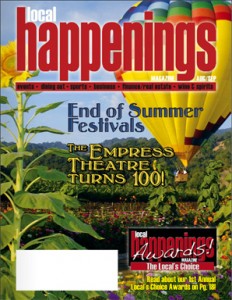
The dog days of summer are upon us but soon the kids will be back in school (along with Robert’s oldest son, who will be venturing into kindergarten – that should be fun!) and Labor Day will be upon us before we know it. There are a lot of great things to do in the next couple of months so make sure to check out all the ‘Local Happenings’ both here in the magazine and online too.
Now that Robert has three kids he has his hands more than full with so many Local Happenings right in his own home – mostly because it is tough to corral all three for a venture out. He will be trekking back east to the Jersey Shore in early August to visit with his wife’s family and to show off the kids – so maybe he will catch up with Snooki and the gang. Deanna is going to keep the west coast going and will probably spend her time at dog parks and horse shows.
While Robert, Regina and the kids are enjoying the sights and sounds of Ocean City, New Jersey, and Deanna is caught up with her four-legged kids, you can enjoy the sights and sounds of Local Happenings’ new digital landscape. Our web site has been redesigned to help bring more events to you via the internet. Please take the time to check it out and give us your thoughts on our changes. We feel that it will help bring the stories to life with the inclusion of images and, down the road, video too. We want to make your stay on our site as good as it can be and allow you to share your information about upcoming events. We will, of course, continue our focus of incrementally improving all things Local Happenings so please do not be shy about sharing your thoughts with us.
We have even more exciting news for you this summer, Local Happenings Magazine will be rolling out a “Best Of” edition in our February/March 2012 issue. You can read more about The Local Happenings Awards here in this issue on page 18. Nominate and vote for some of your favorite businesses and local happenings here in the Bay Area. Along with the ‘Local Happenings Awards’ roll out, we are working to make our website easier and better for you to use so that you can find out about and enjoy even more of these great events that happen every day all around us.
There are some great events coming up in the next two months. The Lafayette Art and Wine Festival is always a great way to spend a weekend. Outdoor music festivals are happening in almost every city each week this summer and fall! The Greek Festival in Vallejo should not be missed. And, while the fair season is wrapping up, it is not too late to check one out. Pebble Beach’s Concours d’Elegance is also taking place in August (one of our feature articles from our June/July issue). The Soroptimist International of Vallejo is hosting their Annual Wine and Dine Gala and I have been told the auction items are supreme. The Tomato Festival is coming up in Fairfield in August and the 38th Annual Fine Arts and Craft Fair in downtown Benicia is on schedule for September. The list just goes on and on. So, make sure to check out our calendar and plan your weeks so that you can take in some of these great events that are happening every day right around us – enjoy!
Happy Birthday Barbara, Karen, Robert, Regina, Freda, Therese, Rich, and of course Happy Anniversary to Robert and Regina, Barbara and Jim, and Karen and Ken!!
Cheers,
Deanna Baillie & Robert Briseno
When Scott Hampton was president of the Lafayette Chamber of Commerce many years ago, he set about to create a city-wide event which would engender a sense of community. As a proper Chamber leader, he sought a way to draw people to the downtown area in order to showcase the many businesses in Lafayette. He envisioned a festival – something similar to the Concours d’Elegance, once held annually at Acalanes High School. In 1995, his vision took life in the form of the first Lafayette Art & Wine Festival. The 3,000 people who gathered at Lafayette’s Plaza Park for wine, good food and a little music made the event a rousing success. Hampton surely could not have predicted that his little festival would morph into an annual marquee event, putting Lafayette on the festival-scene map. 16 years after its introduction, the Lafayette Art & Wine Festival has become one of the premier festivals of its kind in Northern California, and Hampton couldn’t be more pleased.
Nearly 100,000 people now attend the festival, held the third weekend of September in downtown Lafayette on closed blocks of Mt. Diablo Boulevard and Lafayette Circle. It is the largest event in Lamorinda (a term referring to the cities of Lafayette, Moraga and Orinda) and one of the five biggest outdoor festivals in Contra Costa County. Hampton, owner of Lafayette’s Clocks, Etc. on Moraga Boulevard, has been on the Festival committee since day one, and he marvels at the transformation he’s seen in the last 16 years. “Everything has changed, except for the amazing weather!” says Hampton. “We’ve gone from one music stage in the beginning to four music stages. We have over 200 artists, lots of food choices, about 20 beer and wine booths, including craft beers and fine wines in the Premium Wine Pavilion, local artists, hundreds of volunteers and a large committee. We’ve had some extremely hot years, and also the occasional raindrop, but it has always been a beautiful weekend; and we’ve ordered great weather for this year!”
Jay Lifson, executive director of the Lafayette Chamber of Commerce and the event’s sponsor, also remembers the first festival. “It was pretty low key and included a petting zoo,” laughs Lifson. “Within three years it grew and caused us to move it to Mt. Diablo Boulevard. Now we’ve got hundreds of arts and crafts vendors, a wide variety of food options, and specific entertainment just for kids at the KidsZone, where the young ones will find games, arts and crafts projects, music and magic. It’s the same fun we’ve always had, just a little more to recycle.”
The Lafayette downtown area, with its beautiful shade trees, unique architectural blends and easy street layout make a perfect venue for the festival. The vibe is ‘urban meets hometown quaint’. The musical offerings are eclectic, as is the art. Art collectors will find a little bit of everything: watercolors, oil painting, prints, ceramics, photography, blown glass, pottery, wire sculpture, wood working and jewelry. “It has really turned into an end-of-summer party for Lamorinda, as well as a festival,” says Lifson. “It has a small town feel and allows new visitors to Lafayette to meet our merchants along Mt. Diablo Boulevard and Lafayette Circle. We are really lucky having a great partner in BART that stops at the front steps of our event and has additional parking for our guests. We typically have over 40 non-profits participating, getting their message to a lot of people. And, it’s a chance for residents to talk with city council members, the city manager, local police and firefighters.”
As a former employee of Diablo Publications, Orinda resident Susan Stafford worked the Diablo booth at the festival for several years and found the experience to be fun and energizing. “Meeting festival patrons and shooting the breeze creates a sense of community,” says Stafford, who delights in the small-town feel. “I like mingling with Lamorindans, tasting different ethnic foods, dog watching and seeing all the babies in strollers and kids riding on their dads’ shoulders. I like the old-fashioned nature of these festivals – looking at and buying hand-made crafts and watching kids gorge on corn dogs and sticky pink cotton candy. I thoroughly enjoy the mood.”
Chelley Dallara of Eckerstrom Productions is in charge of booking the 200 participating vendors. She has an extensive mailing list from which vendors are obtained, and she regularly sources new vendors from events and happenings around the state as well as from advertising in trade journals and word of mouth. “There are always many new vendors, as well as many of our old favorites,” says Dallara. “There is also a local artist alley featuring Lamorinda artists.”
“The beauty of these events is that they have a little something for everyone,” says Dallara. “And there is always something new to see. The Lafayette Art & Wine Festival has a substantial amount of fine art and I believe part of what people are drawn to is coming out, meeting the artists in person and chatting with them. There are so many unique and interesting pieces to look at. It is fun to be able to talk to the artists and ask questions to know more about the art itself – what thought process or background went into a piece of art – and obtain new levels of understanding about the items that interest us.”
Printmaker Linda Yoshizawa has been participating in the festival since 1999 and, in addition to the camaraderie of the artists and the people watching, the connection to the public is what she most appreciates. “I enjoy talking to people about the process involved in making my monotypes,” says Yoshizawa. “It gives me the opportunity to explain the difference between original prints and reproductions. When I explain what I do I can see that it enhances their appreciation of the artwork. I think that the number of people who are actually interested in fine art has gradually increased. I have had people who come by my booth and say, ‘I have seen and loved your work for years and I am finally ready to buy.’ That makes it worthwhile for me.”
“Lafayette is developing a reputation for encouraging its artists,” says silk painter Maggie Lucas-Hill, who will be exhibiting paintings and her line of table accessories at the festival. “Local artists are pleased that they are valued in the community, and that the Chamber of Commerce wants to showcase us. The festival offers an opportunity for local artists to show their work alongside other seasoned crafters from various regions and provides exposure to a large number of attendees.”
Hampton says the challenge with the festival is to keep it fresh, interesting and enjoyable year after year. Visitors this year can expect new bands in the music lineup, better parking and new Lafayette restaurants and stores in the downtown area. “We book popular, high-quality bands, the art is juried and the food selection is of quality,” says Hampton. “Some of our local restaurants and caterers participate, and we encourage the merchants along the festival route to showcase their wares. We also provide space for the local artists to display their work. With the money that we raise from the festival we donate thousands of dollars to many local non-profit organizations, such as Lafayette Partners in Education.”
Music lovers can expect another great lineup this year. On the Art Stage, at 50 Lafayette Circle, Saturday afternoon and evening headliners include the Spazmatics and Annie Sampson. Playing on the same stage Sunday will be Lafayette’s own Bob Athayde, Dave Martin’s House Party, and Leo Vigil. The Wine Stage, at 3582 Mt. Diablo Boulevard, features a Saturday lineup of Red House, Chubby’s All-Stars, Who Too and Santana Tribute Band Zebop! Sunday’s Wine Stage offerings include Rock Skool, Front Street and the Sun Kings. The third music venue, the Premium Wine Stage, will feature Ragged Glory and Dream Posse on Saturday, and on Sunday, Julia Glyde, Phladdog and ML Crisis will entertain throughout the day and evening.
Hampton’s favorite part of the festival weekend is watching the crowds and seeing people enjoying themselves. He, of course, spends the weekend working. “I start off at 5 a.m. on Saturday working with the committee and the volunteers to get everything up and running for our 10 a.m. opening. The rest of the weekend I am busy working the festival as part of the committee, and also running back and forth to my store, Clocks, Etc., and to our booth in the La Fiesta Square Shopping Center. It is a very hectic but fun weekend.”
“It is simply a festival not to be missed!” adds Lifson.
The Lafayette Art & Wine Festival is Saturday, September 17, 10 a.m. – 7 p.m. and Sunday, September 18, 10 a.m. – 6 p.m.. Admission is free, however, you must purchase a festival glass and drink tickets if you wish to drink the beer or wine that is poured “on the street” or in the Premium Wine Pavilion. Dogs are allowed, but must be kept on a leash and in control at all times. From 10 a.m. – 1 p.m., the pavement is cooler, the temperature is lower and there is ample room for your dog. As the event progresses, it gets crowded and can become dangerous for your pet. No dogs allowed in the food court.
To get to the festival, take BART to the Lafayette Station where you’ll find continuous shuttle service to the festival. If you drive, take Highway 24 to the Central Lafayette exit and follow the festival signs. Free parking is available at the upper lot of the Lafayette BART station. Walking and biking is encouraged. For GPS purposes, enter the address 3535 Mt. Diablo Boulevard, Lafayette, CA.
 Fran is a freelance writer and regular contributor to Lafayette, Alamo and Danville Today newspapers. She lives in Lafayette with her husband, Dan and two teenaged boys, Aaron and Ben.
After nearly four-and-a-half months, the NFL lockout recently ended, much to the relief of fans and franchise employees alike. The NBA lockout, however, is still on-going, and is still in the posturing for public attention and sympathy phase. Many other fans have yet to forgive Major League Baseball for its own strike and lockout which erased the World Series in 1994.
For fans, it is always extremely frustrating each time a collection of millionaires and billionaires starts bickering over fairly dividing up their fans’ hard earned money.
For many other fans, the ideal way to enjoy a game is among devoted friends, watching together at the home of the individual who owns the nicest and biggest TV with a couple of communal pizzas to devour. “Even if (games are cancelled) it doesn’t matter too much, we have a lot of Giants fans in Napa. We all want to watch the World Champions repeat,” Mike S., service manager of Mary’s Pizza Shack in Napa acknowledges. Indeed, restaurants usually have other ways to bring customers through the doors. “It would take the fun out of it, a little bit,” Mike S. admits.
A lot of businesses like alcohol vendors, convenience and liquor stores, should probably expect to see their sales drop if the season is postponed.
Similarly, each fan will suffer the lockout in his or her own way, especially if other activities like gambling or tailgaiting are tied to their viewing habits.
The biggest concerns for local businesses would be if the lockout tragically continues to the point where the season would have to be canceled. If there are no playoffs it would affect local bars and restaurants since fans come in and spend the whole day watching the games.
The lockouts are similar in spirit to The Social Network, former San Anselmo, CA resident David Fincher’s 2010 film that will be remembered long after the movie that won Best Picture at the Oscars (Can you name it now?). Mark Zuckerberg, in the film, was being sued by co-founder and Facebook’s first financier Eduardo Saverin to honor their original contract, which was negated by subsequent contracts. The real question was: Who deserves what share of the profits, the person who put up the funds or the one who does all the work? The question is (and was) at the heart of both the NFL and NBA lockouts.
Fans don’t want to hear about labor disputes between owners and talent. It reminds them of their own jobs. It reminds them of how far they are from their own dreams. What fans want is Joe Montana lofting a pass to an outstretched Dwight Clark, pushing the underdog 49ers over “America’s Team”, the Dallas Cowboys. They want LeBron James put down by Dirk Nowitski playing with the flu to win the NBA title. They want Buster Posey to strap on his gear again and get behind the plate after his ankle heals.
Fans want the drama that is implicit in competition. They want to vicariously live their own lives through the athletes and teams they follow. They want to see a human being excel at his sport’s highest possible level. Fans want escapism.
It is certainly another odd coincidence that the lockouts have run concurrently with the nation debates over raising the debt ceiling and reducing the federal deficit in Washington D.C. Despite the perpetual news coverage and politician spin, the mass public has irritably shrugged their shoulders. Constituents just want the deal to get done. They do not want to hear about how it happened until it is over. Get back to issues that affect the average voter.
It is still too early to say how the lockout will affect the NFL or its fanbase. Certainly practice time was lost, but many veterans often argue over the importance of training camp, as most know the playbook from years past, and know how to stay in shape during the offseason, the same cannot be said for rookies or other players new to the team who usually need several weeks of preparation to get up to par with teammates.
This season, however, for both the Oakland Raiders and the San Francisco 49ers, new coaching staffs, with new strategies, new goals, and new personalities, have been hired. The lockout ate into training camp significantly, so fans could expect to see less than optimum performances by the Bay Area’s organizations, as they will be forced to learn quickly and not as thoroughly as teams blessed by player/coach continuity.
It is also too early to judge whether even a minute of preseason or regular season basketball will be lost. Yet, there is always the negative example for players and owners to remember when staring down the viability of a work stoppage.
In 1994, when the MLB strike/lockout began, Ken Griffey, Jr. and Matt Williams were both on pace to break Roger Maris’ single-season home run record without the aid of performance enhancing drugs (probably). The Montreal Expos had the best record in baseball for the first time in franchise history. Then money and internal politics got in the way. Soon Matt Williams and Ken Griffey, Jr. would succumb to multiple injuries and never again perform as they had when the season ended. The Expos later went bankrupt and are now are known as the Nationals while playing in another city, Washington D.C.
Unfortunately, what returned baseball to prominence was steroids. The names were of the most popular in the game even before they started juicing: Mark McGwire, Sammy Sosa, and Roger Clemens. Records were broken, fans got excited, and the strike was all but forgotten—except by fans in smaller television markets.
Fair weather fans were driven away by the squabbling over how rich players and owners would get. Most of them never came back in places like Oakland or Miami, where teams can barely get 5,000 people to attend a game for under $20 per ticket. In cities like New York, Boston, and San Francisco, however, there were new fans to fill the vacated seats. All that mattered again was the action on the field—and what management was willing to do to put on the best show for a ticket’s worth.
Realistically, however, most people in this country will not be affected by the loss of a major sport. In a culture of too many distractions, it will be one less thing to keep tabs on, one less thing to draw your attention away from what you should be doing instead.
Diehard fans will be at a loss, of course. A similar analogy would be the zealots of the shows The Sopranos and Lost when those iconic programs ended. Most viewers just had to find something else to watch at that time. The truly devoted, however, had to find a new cause to devote their lives.
For now though, fans and businesses have to cross their fingers.
 James Hritz grew up in the Wine Country, but has written for various publications across the country. He is happy to be writing and working in his home again.
[weaver_extra_menu menu=’featuresMenu’ style=’menu-horizontal’ width=’600px’ css=’menu-horizontal’]
A customer runs her fingers along the sleeve of a black Valentino jacket enjoying the feel of the luxurious leather. The retail price for the jacket, which still has its original Neiman Marcus tags, is $2,498. The label on the jacket is $598. Unbelievable.
Consignment stores recent inventory acquisitions is an example of the high quality, designer-brand merchandise available in upscale consignment shops around the Bay Area. For a fraction of the retail price, shoppers can find new to gently used, moderate to high-end brand clothing, designer jeans and accessories from $10 and up. “Because of the economic downturn, there is a real market for designer labels in the consignment setting,” says East Bay fashion blogger Moya Stone, “Right now, people are not comfortable to pay full price for designer wear, but they still want it.”
Angela Valente-Romeo is always on the lookout for consignment shops that carry designer apparel. She began shopping at consignment stores in the 80’s when she was looking for business clothes on a budget and got hooked. “I look for the higher-end, more unusual labels. They are a really good value,” says Valente-Romeo. And if she likes a consigned piece, but the size is not right, she finds that well-constructed, designer brands can often be easily altered. “You get a great bargain, even with the cost of alterations. It’s a no-brainer.”
Recently there has been an upswing in both consigning and shopping at consignment stores according to Stone. “The economy is a big factor. Women are turning their clothes over more quickly, opting for the cash or store credit,” she says, adding, “The increased commitment to recycle and reuse plays a part as well.” The availability of maternity and men’s wear, petite and plus sizes and deeply discounted new apparel are factors that contribute to the surge in consignment store shopping, but it’s the boutique shopping experience that gets shoppers in the door.
A look inside four local consignment stores reveals what is unique and “boutique” about consignment shopping today.
A Dress Change, Danville
One of the attractions to consignment shopping is the search for a great value, says Donna Read, the owner of A Dress Change in Danville. “It’s all about the hunt, finding that diamond in the rough.”
When Read opened her consignment store in November of 2009, she knew that, in addition to carrying upscale merchandise ranging from jeans to minks at ¼ to ½ of the original cost, the store’s personality was integral to the shopping environment she wanted to create. The walls of Read’s 1,800 sq. ft. space on Railroad Avenue in Danville’s Old Town district are faux painted in rust and sage green, the dressing room curtains are made with a leopard-print fabric and there is an inviting smell of eucalyptus in the air. “When you walk in my store, you feel like you are in a fine boutique, and you are treated that way. My staff knows the inventory, and they are attentive and helpful,” says Read.
“The neat thing about Danville is that it is a destination for consignment shoppers. There are four consignment shops in this city,” Read says, a self-described consignment junkie who formerly worked in human resources. “Having a background in human resources is a plus, because this really is a people job. I love working with clients.” She sells about 1,400 items per month. To manage the movement of so much inventory, Read has a robust, automated tracking system which allows consignors to check their accounts online to see what has sold and for how much, which they can take in cash or as store credit.
Molly B’s Maternity Exchange, Walnut Creek
For 30-year-old Molly McCann, the idea of maternity resale made sense. “I have always shopped at consignment stores, and the availability of maternity clothing was really limited or nonexistent. I couldn’t understand why,” says McCann, who opened Molly B’s Maternity Exchange just off north Main Street in Walnut Creek this year. She buys, sells, and trades new and very lightly used maternity wear, and pays cash or gives store credit up front.
“Everyday a pregnant woman’s body changes,” says McCann. Sensitive to the pregnant woman’s need to continually resize, McCann keeps her prices low. Most of the clothing is priced at $25 or less and women can “trade up” in size throughout their pregnancy. Designer jeans sized for the pregnant body are one of the most popular items. “Almost 80% of designer jeans are available in maternity styles but are not sold in traditional retail outlets, just maternity stores,” says McCann, whose recycled maternity jeans range from $50 to $65. She also sells lightly used parenting books, like the compulsory What to Expect series, for $3 to $6 and handmade baby, toddler and mommy items by local crafters including sleep sacks, diaper bags, and nursing cloths.
Labels, Walnut Creek
Nice opened Labels’ Walnut Creek location 12 years ago and was a forerunner in the area to the concept of combining consignment and designer apparel in a boutique setting. The storefront window displays three chicly dressed lady mannequins (who would look at home lunching at one of the many outdoor cafes nearby) and a stack of brightly colored handbags. Inside, the 3,000 sq. ft. boutique has hardwood floors, high ceilings with white crown molding, and several custom built-in cases to display the clothing which is organized by designer including top tier names like Chanel, Gucci, Louis Vuitton, Prada, Hermes and ready-to-wear princess Diane von Furstenberg. The expansive variety of colors and styles, and lack of repetition, provide the only clues to the fact that the inventory is not traditional retail apparel.
Dressed in a yellow and green swirling patterned long skirt paired with a mock-neck black top and low-rise stretch boots with peek-a-boo heels, Nice moves energetically about the store, greeting customers and providing personal attention to their shopping needs. Her style is artistic, elegant, and always welcoming. “Shopping for clothes is an outing. I like to make it personal and enjoyable,” she says. Nice has over 5,000 active consignors, many of whom have consigned with her for several years, and she estimates that 75% of her consignors shop consignment as well, even if they were reluctant to at the start. “It’s all about quality. I try to carry designers that are attentive to construction, fabric, and detail. Quality pieces that literally last a lifetime.”
Consigning Women, Napa
Rhonda Jamison describes herself as a tomboy who loves clothes. Her nickname is Bruce, she knows how to build and fix things, and she is the owner of Consigning Women in Napa. “I’m in this business to be a service to my community,” says Jamison, who took ownership of the store last September. “Consignment shopping is a great option because you can find great pieces at reasonable prices.”
Consigning Women has a cool, urban vibe. Recycled vintage wood doors serve as counters and wall décor. “The whole store is green,” says Jamison, who drives a compressed natural gas van for the business. “I’m in the consignment business so it is important for me to be consistent across the board.”
After relocating several times during its 13-year tenure in Napa, Consigning Women is now centrally located in the tourist district and the store is attracting a new segment of shoppers. “Women on vacation come into my consignment store then hit the wineries,” says Jamison. “They can find that one unique thing that their friends back home won’t be wearing.”
In addition to high-quality consigned clothing, Jamison also carries new apparel that she sources from buyers’ markets in Los Angeles and as far away as Santiago, Chile. “I get boutique style and quality at low cost and pass the savings along to my clients,” says Jamison. She sees her inventory moving toward half consignment and half new, but all available well below the cost of retail. Jamison has also introduced consignment kids, maternity and menswear. “For men, the focus is on casual wear with brands like Ralph Lauren, Dolce & Gabbana, Calvin Klein and Kenneth Cole,” says Jamison. “I can get your husband dressed smartly and inexpensively for a night out,” she adds with smile.
Sold!
Not long after a kidskin Valentino jacket was on the floor, a new client tried it on, loved it, but decided not to splurge on herself. Two days later her husband found his way to his wife’s favorite store (his wife had mentioned the jacket in passing) and purchased the jacket for her as a birthday surprise. It was wrapped in a shiny black box with white satin ribbon, and he picked it up just in time for her birthday celebration. The client came in to the store shortly afterward and she was just thrilled. She plans on having the piece forever!
 Andrea Firth is a freelance writer based in Moraga, CA. She likes to spend her free time running, hiking, golfing, traveling … and occasionally shopping.
Ever think about how many contracts or agreements you enter into every year? Certainly, you take the time to read each one before you sign or “click” your assent, right? Be honest, do you have even a clue as to what’s in that 60-page software or user agreement that you just clicked “I Agree” to?
The truth is that most people sign contracts and click away with reckless abandon. And most of the time it doesn’t matter because everything goes as planned. The supplier provides the product or service as agreed, and the consumer pays or otherwise meets the terms that were agreed to. In fact, except for the few times when something goes wrong, or one or both of the parties don’t perform as agreed, the contract is meaningless and can gather dust. So in contract law, we say that it doesn’t matter until it matters – but then when it does matter, it can really matter.
The question arises as to how one can remain protected without having to hire an attorney every time he or she enters into a routine transaction. That answer includes several steps.
It’s first important to determine the significance of the contemplated transaction. For example, you can be justifiably less concerned when clicking your assent to the terms of your latest iPhone app than you should be when signing a loan agreement for the purchase of a car or a home. Loan agreements commit you to significant and often long-term obligations for which the ramifications for noncompliance can be substantial and costly. An iPhone app can usually be cancelled at will.
If you’ve determined that the contract/agreement is one that requires more thoughtful consideration, next identify if it is one that is subject to further negotiation, or is an “adhesion” contract. This is an important distinction for several reasons.
An adhesion contract is one that is presented in final form for acceptance and is not subject to further negotiation. It is offered by a party with superior bargaining power on a “take it or leave it” basis. Examples of adhesion contracts include cell phone agreements, insurance policies and the liability disclaimers that are always printed on the back of the claim tickets you receive in a parking garage.
If you determine that the contract you’re contemplating may be subject to further negotiation, then take advantage of the opportunity. Even some agreements that appear to be adhesion contracts, such as leases, may present opportunities for the negotiation of some material terms.
When negotiating, be aware that if a court is ever invoked to enforce your agreement, it will view its job as one of interpretation – to evaluate the legal enforceability of the terms – and rarely the “fairness” of what was agreed to. For example, in a contract for the purchase of a vehicle, it is no defense and, frankly, is a waste of time and good oxygen, to try to convince a court that you should be let off the hook from any further payments because the seller charged you too much for the car in the first place. If you knowingly agreed to the price, and you were of age to contract, sober at the time and there are no allegations of fraud or misrepresentation, you will not be protected from your own ignorance if you agreed to overpay for something.
Because adhesion contracts are not subject to negotiation, sometimes courts will refuse to uphold them if they determine that the unequal bargaining power of the parties resulted in a situation that is so unfair that enforcing the terms would be unconscionable due to the procedural circumstances surrounding the procurement of the agreement, or the substantive terms of the agreement itself.
Realize that it is an extreme case when a court will not enforce an adhesion contract. The mere fact that a contract is one of adhesion will not singularly provide the basis to relieve a party of its obligations under such an agreement.
It’s not possible to address all of the preferred contract terms for inclusion – and exclusion – in one article. However, when negotiating a contract, here are some noteworthy terms to consider:
Term – Every contract should include a defined term for the period during which it is operative and, specifically, when it terminates. Make sure the contract term is one you can live with based on your current and anticipated life circumstances and resources.
Subject Matter – Ensure the product, service or other subject matter of the contract is clearly defined and consistent with your understanding. For example, if you contract for a brand new refrigerator, verify there is no right of the seller to substitute a remanufactured or demonstrator model.
Responsibilities, Liability and Risks of Loss – At its core, the primary intent of a contract is to allocate the duties of the parties in the event that things do go wrong, there is an understanding as to which bears responsibility. Be clear about such things as:
Which party bears the risk of loss if the product is damaged in transit?
What happens if the product fails after a week? A month? A year?
Who is responsible if a third-party is injured by the product?
Who maintains “title” to the property? (Hint: Bet you didn’t know you probably don’t “own” the rights to your wedding photos.)
Are there use, resale or other restrictions on your ownership? (for example: A friend who purchased a rare breed of cat had to agree it would never be allowed to roam outdoors.)
Venue – Ensure that disputes arising under the contract are heard in your local jurisdiction. In our age of Internet commerce, many companies establish in the contract that disputes must be brought within their local jurisdiction. Do you really want a requirement to bring your small claims case for $400 in West Virginia?
Attorney Fees – In most cases, it makes sense to include a provision allowing for the prevailing party in a lawsuit to recover reasonable costs and attorney fees from the losing party. This type of provision may discourage frivolous lawsuits because there is a certain amount of risk involved when filing. However, with an attorney fee provision also be aware of the following:
You may not want to include an attorney fee provision if the other side does not have sufficient resources to pay your attorney fees. In such a case, if you’re the prevailing party, the provision could only work against you. And …
Be aware that some attorney fee provisions are written in such a manner as to only award attorney fees to one party if that party prevails in litigation. This goes in the “nice try” category. Under Civil Code §1717, a one-way attorney fee provision applies equally to both parties. Therefore, regardless of the contract language, the attorney fees will be granted to whichever party prevails.
Mediation – Mediation is a process whereby a neutral third-party assists disputants in resolving their issues by facilitating communication between the parties, rather than evaluating evidence or rendering a decision. The process is quite successful, and many contracts include a provision whereby the parties agree to attempt to resolve their disputes at mediation prior to the filing of any subsequent lawsuit.
Arbitration Clause – Beware the arbitration clause. Simply put, a binding arbitration clause in a contract allows the parties to bypass the judge, jury and courthouse and go directly to a private arbitrator. There they will receive a judgment (called an award) that, except under very rare circumstances, is final and binding (cannot be appealed), and which, according to the California Supreme Court[1], does not have to follow the law even if it causes a “substantial injustice to the parties[2].”
The frequent use of arbitration started innocently enough many decades ago as a voluntary process between contracting parties to solve the problem of lengthy court delays, logistics and rising costs of litigation. It has morphed over the years into a mandatory provision of most employment, banking, consumer, health organization and other agreements. It remains an opt-in provision for most real estate agreements. The simple click of assent, or the stroke of a pen invoking an arbitration provision makes a huge difference in the rights of the parties, and how subsequent disputes under that agreement will be handled.
This is not to say that arbitration is always a bad alternative. But it is important for contracting parties to be aware of the significant decision that is being made, and the rights that are being exchanged, when agreeing to such a provision. Also, on balance, most of us like some predictability. And knowing that an arbitrator is not required to follow the law in rendering a decision may be a bit more of a gamble that most of us are willing to take.
So the next time you decide to click that “I Agree”, or sign away like it doesn’t matter, be informed, because someday – it might matter.
 Stephen Gizzi is the Managing Partner of Gizzi & Reep, LLP in Benicia. He is an attorney, mediator and serves on the faculty of the National Judicial College in Reno, NV. The information in this article is intended to be general in nature and does not constitute legal advice. Consult your own legal counsel for your particular circumstances.
Deciding a career path is perhaps the toughest decision to make in one’s lifetime. How does anyone figure it out? Following in your parents’ footsteps is a common option, reading up on a class that was taught by an inspirational teacher could certainly lead to a career, but for Darren Wong, also known as Darren J. Wong, DDS, of Family Dentistry in Vallejo, the notion to be a dentist hit him hard, quite literally, as a passenger in a car accident.
As an early teen, Wong was drinking a bottle of Coke as a passenger in the back seat of a vehicle when it got hit from the side by an oncoming car. He was thrown into the seat in front of him and the Coke bottle caused severe damage to his front teeth. “They put me though oral surgery, they put me in braces through two-and-a-half years,” Wong recalls. “Ever since then I wanted to become a dentist.” He remembers the orthodontist telling his mother that they might not be able to save his front teeth, but could “possibly try something.” That struck a note with him – how to save someone’s teeth. Even as a pain-stricken 14-year-old, he was interested in the procedure and at that point decided his future in dentistry. “It was a pretty easy decision.”
“Initially I wanted to be an orthodontist,” Wong says. “But after I’d gone to dental school I didn’t want to be confined to just doing braces. I wanted to be a general practitioner.” There were no dentists in his family but a few of his uncles were physicians, one being a plastic surgeon. When deciding his career in medicine Wong asked their advice and they responded with the simple question: “Do you want someone’s life in your hands?” to which he responded “Not really.” Dentistry was the perfect fit for Wong. “You work everyday with your hands, it’s normally non-life threatening, it’s a much nicer profession, I think.”
Wong has now been a practicing dentist in Vallejo for 24 years. “I’ve seen three generations,” he says. “That’s how the ‘old physicians’ used to be: my daughter would see my physician, her daughter would see my physician … if you’ve been in business long enough you start seeing that.”
Family Dentistry is the name Wong decided for his practice. “We want to provide dental care to the entire family,” he says. Some dental offices only see children from 18 months to 12 years of age, while others only want to see adults. “I want to make our practice open to everybody,” he says. “It’s just like taking a car in for a checkup, you need a break job and they say ‘We don’t do breaks.’ I like being a general dentist. We see kids as young as 18 months and our oldest patient is 95.”
It’s that variety of patients, as well as changes in the field, that keeps Wong excited about his job. “It’s not static,” he says. “Something’s always new in dentistry. We’re always learning.” Things change so fast with the speed of technology that one must always remain alert and focused. “It’s not something that you learn once and do it for the rest of your life,” he says. “I’m not even using probably 20% of what I learned in school … it keeps you interested.”
The most recent technological advancement incorporated into Wong’s Family Dentistry practice is the use of lasers. After rigorous training and passing numerous exams, Wong now uses a Class 4 laser. “It’s neat,” he says. “It takes place of the scalpel – a cutting knife for surgery. The laser does the same thing but you don’t bleed because it cauterizes at the same time.” And it’s not just for cutting, but a number of other things, he explains. For example, “you can heal canker sores with it in half the time.”
When Wong went to school they weren’t using lasers. Actually, much has changed. “We didn’t have digital x-rays and now we are using them. We have better diagnostic tools. Even the injections have gotten much better; we haven’t quite found a way to get rid of the injections completely, but we’re getting there.”
Wong explains that one of the biggest misconceptions people have about going to the dentist is that they only look at your teeth. “We look at everything: oral soft tissue, lips, tonsils, saliva glands, joints…” He explains that there are other systemic problems that can be discovered by a trip to the dentist (i.e. diabetes can affect the gums, and periodontal disease can affect your heart and your joints). Typically people think that if they’re not in pain, then there’s no problem or need to see the dentist. Wong gives the drastic analogy of when a person gets diagnosed with cancer, they’re often not in pain at the time. It’s when they begin to feel the pain that it may be too late for medical assistance. “You don’t want to wait until it hurts,” he says. “That’s why you get your teeth examined every six months at a minimum.”
Flossing helps. Everyone is aware of its importance though few of us embrace flossing as a critical portion of our hygienic routine. Indeed a man of analogies, Wong explains that when a person showers, they generally wash underneath their arms and feet. “When you brush your teeth [without flossing] it’s like giving your teeth a shower but not washing under your arms and your feet.” But even so, flossing takes time, to which he responds: “I tell people if you started flossing twice a day for the next two weeks, you’re time would be cut in half by the end of the two weeks; your dexterity is not honed right away.” And if you think there’s a way to get out of it, you’re wrong. “There’s really no substitute for floss, yet.”
“Dentistry is evolving toward a more cosmetic profession,” Wong says. “With fluoridated water being more prevalent in California – it strengthens your teeth – we’re seeing less amounts of decay in people.” One of the most common cosmetic dental procedures is teeth whitening, and the method you should take when approaching it really depends on your age. “The younger you are, the better store-bought materials will work for you,” says Wong. “They tend to work best on teenagers, ages 20, 21, because your teeth haven’t discolored that much by then.” It is in your later years that a teeth-whitening trip to the dentist could be in your favor. “When you get older the dental office can use much stronger material.” He recommends trying the store bought items first, though that usually takes anywhere from 7-10 days for the full effect. At Family Dentistry the process takes about an hour.
Other cosmetic procedures include standard crowns and bridges, all-porcelain restorations, white composite fillings, restoration of implants, laser gum surgery, etc. The most commonly requested service is for caps and veneers. “The only thing I don’t do is braces,” says Wong. One of Wong’s favorite procedures to perform is known as Smile Design. “When someone smiles sometimes you see all teeth, or just as much gums as teeth. With smile design we try to fix that without major surgery by trimming the gum tissue, making the teeth look longer than they are … to make their smile more to what the patient would like to see.”
While this article is all about Dr. Wong, “It’s not just me,” he says. “It’s my whole staff that makes us stand out. When you come in here and we treat you, we’re not just treating a mouth, we’re treating a person.” Just as the name Family Dentistry implies, “Once you’re here, more or less you’re like a family member,” Wong says. “You are our number one priority.”
 By Matt Larson: Matt Larson is not just a writer, he does lots of other stuff with his time. Example? Sure! He hosts stand-up comedy shows and would like YOU to attend on August 28, 2011 at the Fetterley Playhouse in Vallejo! Info @ www.thecomedycircuit.com.