Your Tie, Their Tai, Mai Thai
Prior to visiting this restaurant I was not sure what I was in for. It could have been any of the following:
My Tie – a men’s accessory
Mai Tai – a tropical drink
Mai Thai – a great restaurant!
When my husband and I first ventured into Mai Thai, located in Benicia, we were met by “Mac”, the owner, and his wife “Karen”. Now Mac and Karen are not their real names. They really are Chirawut Assawapratart and Panaptaporn Imsunpang, but, like most Thais that relocate to the states, they adopted an easier “western” name to help us pronounce it more easily. As an aside, I have always wondered if I moved to Asia if I would want to adopt an “eastern” name to help them pronounce it more easily … Mai Thai is located along 1st Street, the main drag of Benicia, and there is always plenty of free street side parking. When I first walked into the restaurant, I was taken back by the modern look and feel of the place. Dark, streamlined wood and lantern lighting above each station. There are tables where you can eat traditionally, on the floor with your legs in a type of gully – they were very cool. If you are the parent of young children, it might even be a good place to contain them while you eat!
Now for the name. I was under the impression that Mai Thai was more a reference to ownership, such as “My Thai”. The true meaning is much different. The actual meaning of Mai Thai is a reference to a type of Thai silk fabric that is some of the finest and most exquisite silk in all the world. The way they weave the silk changes the color of the fabric by the way the light hits it, making it seem iridescent. It is said that Thai silk is first hand woven from individual strands to achieve a single, usable fiber. This process takes up to 40 hours just to get a half a kilogram of usable silk. This process of hand weaving produces a silk that can’t be produced by commercial machines.
There are, of course, lower quality machine-made artificial silks, but the “wedding ring test” will easily separate the high quality Thai Silk from the rest. The wedding ring test calls for taking a yard or two of the fabric and running it through a wedding ring. Authentic Thai silk is of a quality so delicate, flexible, smooth and strong that it will flow easily through such a small opening and it will do so without snagging. Low quality imitators will be caught by the ring when you try pulling it through the opening. The material will not be as delicate or strong and it will bunch up and snag, becoming impossible to pull through. Also interesting, real Thai silk, when burned, will smell like human hair and imitation silk will smell like plastic. In addition, if you remove the flame, true Thai silk will stop burning almost immediately as imitation will continue to burn until all the fabric is gone. The walls of the restaurant are adored with pictures of the silk-making process, and some of the finished product. Their menu includes facts about Thai silk as well.
So what does silk have to do with a restaurant? They choose the name Mai Thai because, as special as this fabric is, they wanted their restaurant and food to be of the same high quality. Just as the silk changes color based on the direction of the light, their daily food specials also do the same, offering their guests a different view of their native food. They want their guests to experience all the rich flavors of their homeland and they only want it to be of the highest quality.
Now for those of you that have never had Thai food, I will warn you now that it can be spicy. Thai food, like many Asian cuisines, revolves first around rice, then fish. Thais use a variety of very hot chili’s in their cooking as well as coconut and basil. They make quite a few curry dishes and they also have a wonderful peanut butter sauce that they use for grilled meat. Thais are also well know for their barbecue, which is sweet and spicy.
Mac and Karen did not want to be a westernized Thai restaurant, but instead wanted to bring the true flavors of Bangkok, Thailand right to their customers’ table. I have to tell you that it was a memorable journey.
We started our grand adventure in Thai cuisine by having fried fish cakes served with peanut sauce, along with cucumber salad with peanuts. The cakes were very springy and fresh. We wasted no time by then tasting the Chicken Satay (pronounced SAH-tey) served with a traditional peanut butter sauce served on a beautiful leaf-shaped plate. Now if you have never tried satay before it is a simple dish, just the meat and some spices, so the flavor really has a chance to shine through. The peanut butter sauce has a mild spice to it and trust me when I say that it is not what you would serve on your child’s next PB&J. It was delightful. Our final appetizer was an order of their spring rolls with a mild spicy sauce made with vinegar. These were something special and again, very fresh and crispy.
Next we moved on to three of their classic Thai plates which Mac selected for us. Pad Thai, which is a thin, translucent rice noodle. Pad Thai is a very traditional food with subtle flavors. A perfect mixture of spicy and sweet, but not overpowering. We had the Tofu Pad Thai and it was delicious. We also had the Mose salmon dish that was split with one side having a red curry and the other side a green curry. The dish was complemented with eggplant, bamboo and asparagus. Now this was a real treat. The salmon was cooked to perfection. Their curry just enhanced the natural flavors of the salmon. The green curry in particular, which had a little spice on the back end, was absolutely fantastic. Finally, we had a Cashew Chicken which was also very tasty. This dish is a bit on the sweet side and served with spicy sweet chili sauce. Don’t let the chili’s scare you – it is not very spicy. I would point out that many people would consider Cashew Chicken a Chinese dish – and they would be right. Thailand is heavily influenced by their not too distant neighbor to the north and many Thai people today trace their ancestry back to China.
Just when we thought we could eat no more, dessert came along. The perfect ending to our wonderful meal was fresh mango served with a sweet coconut sticky rice. If you are a fan of coconut, this is the dessert for you. The rice was slightly warm and the rich taste of coconut was the perfect accompaniment to the freshly sliced mango. A simple dessert but very delicious. My husband, a huge fan of the coconut, devoured it with glee.
Their menu has a wide variety of traditional items including Thai spring rolls, salads and soups for starters. Main courses include multiple Pad dishes from which to choose from including Pad Basil and a variety of curries: yellow, red and green. The day of our visit Mai Thai had daily specials that included spicy cat fish, black pepper corn cat fish, prawn fried rice, honey roast duck and barbecued chicken. As I said earlier, barbecue is a very traditional and common Thai offering and they do it quite well. If you have not had Thai barbecue, you should try. The barbecue has a sweet honey glaze on it with just the right amount of spice. They have a variety of rices too. Don’t miss the fried rice, pineapple fried rice or a prawn fried rice. Or if you like, they have white and brown rice which are both very tasty.
Mac and Karen are keeping everything about the restaurant very traditional to the Thai culture. If you are not familiar with Thai food and unclear about what you are ordering they have a picture book of all of their dishes so that you can determine if it is right for you. This will help you visualize what you are ordering and get ready for your excursion into the world of Thai cuisine.
There are plenty of beverages to enjoy with your meal as well, including the traditional Thai tea which is also known as Thai Ice Tea. This drink is made from strongly-brewed black tea. Other ingredients include orange blossom water, star anise and crushed tamarind seed. This tea is sweetened with sugar and condensed milk and served chilled.
Mai Thai also has a small bar area where you can enjoy an adult beverage, including some traditional Thai beers like Singha & Chang. Japanese Sapparo is also served along with some Mexican and domestic beers as well as some local wines. Mai Thai does not hold a full liquor license but this does not stop them from hosting a Happy Hour every day between 5:00 p.m. and 7:00 p.m., with half-price appetizers and drink specials.
Mai Thai is open Monday – Saturday for lunch and dinner, closed on weekday afternoons in between meal times. It is also open Sundays for dinner only.
It was a true pleasure to sit down and enjoy not just the food, but the ambiance of Mai Thai, as well as discovering the history of the owner, his wife and their three children. Please take the time to visit the restaurant and let them know that you learned about them in Local Happenings.
 Regina Briseño – Recognized for her work with her family and talent for seeking out good food and wine, she also invites everyone to come and enjoy the adventurous ride with her!
[weaver_extra_menu menu=’featuresMenu’ style=’menu-horizontal’ width=’600px’ css=’menu-horizontal’]
Looking at 100
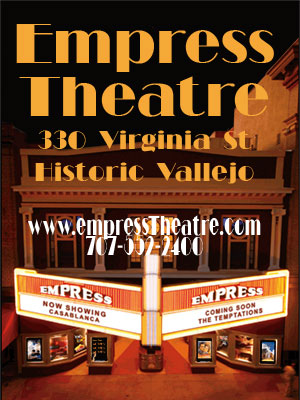
100 years old, 1 century of time, 36,500 days. It is always an important day when something reaches that milestone. In 1912 the Republic of China was also formed. New Mexico became the 47th state. The girl scouts formed. The RMS Titanic set sail in April of that year. Both Fenway Park in Boston and Tiger Stadium in Detroit opened for play. The 1912 Summer Olympics in Sweden took place. American actors Karl Malden, Danny Thomas, Gene Kelly along with Golfer Ben Hogan & Sam Snead, Singers Perry Como and Woody Guthrie and Chef Julia Child were all born in 1912. Amid all of that, on February 14th (Valentines Day) the Vallejo Empress Theatre put on its first production (construction was actually completed on the building in October of 1911). While all of those people named are no longer with us and the Titanic sits at the bottom of the ocean, the rest of those things are still with us. The Empress, through it all, has served as a theatre. Not always the most glamorous, but a theatre none the less. I thought with that upcoming notable date it would be a good time to reflect on the theatre and its recent rise from the proverbial ashes to once again enjoy all of its glory. Growing up in Vallejo, I remember going to the “dollar” movies there in the mid 80’s. While the theatre at that time had certainly seen better days, it was still a beauty. I remember staring up at their ceiling and looking at the fabulous filigree and scroll work that adorned it and thinking how much history it had seen and how much work went into making something that many of us do not give a second thought about. It was a true work of art. After the 1989 Loma Prieta earthquake, it seemed this old grand dame was destined to finally close her doors for good. The quake had exposed its weakness, its seismic instability and the theatre would sit dark and gathering dust for almost 20 years.
Like the mythical Phoenix though, the Empress has reemerged from the proverbial ashes and dust to regain her former glory. The Empress has now enjoyed a full restoration that began in 2006, which included a full seismic retrofit. The renovation maintained all of the charm and history of the building while bringing it up to current building standards. This was not just cosmetic enhancement but a full renovation that dealt with a few structural challenges the building had. In addition to the seismic retrofit, the complete ventilation system was replaced and air conditioning was added. An under ground river that had long plagued the building was finally addressed by installing pumps that now run 24/7. The stage, which was only 12 feet in depth, was renovated so that it can now reach out to 36 feet and is capable of having a live orchestra play during performances. The theatre is now primed for both stage and screen production. The guest amenities are, to say the least, lush. They include rich, red velvet seating and that magnificent ceiling has been lovingly restored to its full glory – including its gold leaf accent. One feels as if they slipped into a theatre from the 1920s – though now you can enjoy a stage production or movie in the comfort of mechanically cooled air. Upon walking into the theatre for the first time you might expect to rub elbows with Jay Gatsby or Greta Garbo.
While the theatre has now been fully restored, all the challenges have not been fully overcome. When the renovation first started, it was envisioned that this theatre was to be the crown jewel in a full downtown renovation aimed at bringing new vitality to the aging area – vitality that had vanished due to poor city planning and the loss of the city’s main economic engine – Mare Island Naval Base. New buildings that would bring people and businesses would have dotted the landscape and brought a live, work, play environment that had not been seen since the 1950’s. Along with an adjacent waterfront redevelopment plan, the entire area was going to be a hub of activity both in commerce and entertainment. Alas, the housing bubble that had driven the development in the first place exploded and the development has been put on the shelf. While some money has been found to complete some streetscape work along Virginia Street, were the Empress sits, much of the plans for the area remained confined to paper.
Despite the national economic malaise, a mini restaurant revival has taken place over the last few years around the Empress. A wonderful Cuban restaurant has opened next door (Havana Sol) and great barbecue joint (Gracie’s) has also opened down the street and they are both doing a wonderful job to develop foot traffic in the area. Adding to those two establishments, three older restaurants along the nearby waterfront have been renovated as well (the Front Room, Zio Fraedo’s and the Sardine Can). Two coffee shops (Java Jacks and Panama Reds) and great breakfast/lunch establishment (the Good Day Cafe) were also added to the downtown. When combined with the established restaurants in the downtown (My Home Style Café, China Wok, El Nopal, House of Lechon, Kowngnan & China Cafe) and the two taverns in the area (the Town House and Dunphy’s Tavern) there are quite a few culinary and entertainment choices. Havana Sol, Gracie’s, the Town House, the Front Room, Zio Fraedo’s and the Sardine Can all feature live music on varying nights throughout the year.
The area is struggling with a misconception that “there is not much to do in the Vallejo Downtown.” This is simply not true. While not the shopping mecca it was in the 1940’s to 1960’s, the area is now a true dining destination for the city. The Empress simply needs more people to rediscover this hidden jewel. The theatre was not established with an endowment and just as it was reentering the world from its long hiatus, the city of Vallejo, the State of California and the Nation as a whole has slipped into its own economic challenges. The city was unable to financially support the arts on any level and the theatre was left to fend for itself. A few grants helped it in the early years but not enough for the theatre to fully realize its true potential. The theatre, while in constant search for grants, operates solely on incomes from events, rentals and donations. The cost to operate the theatre is not cheap, at a base line of $8,000 a month just to keep the lights on, it has been a struggle.
The Empress Theatre itself is operated under the stewardship of Vallejo Community Arts Foundation (VCAF). It is these dedicated volunteers that have worked to keep the theatre open and remain an important component of Vallejo’s contribution to the performing arts for the community. Two of the board members, Susan and Tim MacDonald have also been the largest contributors to the theatre. Currently they are going above and beyond the call of duty by offering a “2 for 1” matching donation to the community in their “Raise the Curtain” campaign. They are pledging $2 for every $1 dollar donated to the cause of making the Empress a true economic engine for the city and the region. Even in these tough economic times, this current campaign has raised almost $5,000 and, when coupled with their 2 for 1 offer, it brings the total to almost $15,000!!! These funds will enable the Theatre to get through the summer and into the Fall Program, which is generating a tremendous amount of excitement. Their longer term goal is to raise at least $100,000 from the community to help the Empress on a longer term plan. For a complete schedule of their upcoming events go to their website: www.empresstheatre.org.
VCAF also just ran the highly successful 2011 Summer Arts Camp for the kids, which sold out, and was supported through generous donations from The Executive Lions Club, Greater Vallejo Recreation District and several wonderful private donors which enable underprivileged kids to attend. In the words of the VCAF board;
“We need to have the entire community embrace the performing arts in Vallejo. This is not an effort for a few but must be supported by us all. The Empress Theatre needs to be open all the time for everyone. But we need your support to do this! If our community is to have a thriving and living theatre, it is only going to happen when the community cares. We should all be grateful and thankful that we have a theatre that hundreds if not thousands of communities would be proud to have. But it is up to each of us to do something about it. It’s always the right time to do the right thing. They are asking for the community to get involved and to help make the vision for a vibrant art community a reality sooner. They are also asking the community to contribute funds in any amount. They also know that is a challenge with the economics of the area and the nation but for those that can’t give financially they also need volunteers. If you can assist them with productions – from stage hands to ticket takers, they need your help!
Those who would like to contribute are encouraged to mail your tax deductible (they are a 501c3) contributions to: Empress Theatre, P.O. Box 1767, Vallejo, CA 94591.
To volunteer or to inquire about shows you may also call the Empress at: (707) 552-2400. You may also visit their website: www.EmpressTheatre.org
When we started Local Happenings Magazine in 2009, venues like the Empress were one of the precise reasons that we did. There are so many things that happen in our communities, right under our very noses. Our goal was not only to help you learn about all of these great things, but to help these great events to be advertised. Without active participation from the community at large, these events will not survive and without these events, we do not culturally survive. Help your community to grow and thrive by attending and helping to put on these events. Many of you would be surprised by the sheer number of these events that happen every day – I know I was – so it is easy to get involved. If you do not live in Vallejo there is probably a community theatre not to far from your home, and if you have not been there you should go and experience it. In some cases, the quality may be uneven but the only way it will improve is by people attending the performances. Larger crowds draw better talent, which in turn draws even bigger crowds. After all, long before Hollywood was what it is today, it was farm land – the people made it what it is today. We too, as individuals, make our community what it is. Get out and enjoy your community and join in the process help to make it better – enjoy!!! Happy 100 years Empress – we all look forward to 100 more!
 Robert Briseño and his family love to help the communities that they live in – after all it is what you make it.
[weaver_extra_menu menu=’featuresMenu’ style=’menu-horizontal’ width=’600px’ css=’menu-horizontal’]
Something to Check Out
In my teenage years, my appreciation and love of the written word brought me to my local library. I enjoyed my time there so much that I began to volunteer and eventually applied for my first (and so far only) job there as a departmental aide. The staff of librarians, library aides and other departmental aides became my second family for 3 ½ years. The John F. Kennedy (JFK) branch became my second home. The staff of JFK watched me grow from a timid 17-year-old into the grown and ambitious woman who is typing these words. Now, a graduate of Solano Community College, I will soon begin classes at Sonoma State University in the fall to pursue my career as a journalist. The article you hold in your hands happens to be my first paid work; this opportunity given to me by Local Happenings Magazine to command the beginning of my career.
Libraries have changed significantly since their creation, observing the changing technologies and needs of the people. From etching thoughts onto stone slates to having millions of fiction and non-fiction titles viewable from a tablet computer with a brilliantly glowing touch screen, much has changed indeed. Amazing technological strides have been made, and continue to be made by modern libraries to uphold the written word and its excellence all over the world.
Having worked at the John F. Kennedy branch in Vallejo for such a significant amount of time, and during what were perhaps the most formative years of my life, it is my honor to share with the readers of this fine publication all that the library has to offer its patrons, such as its resources, events, programs, and collections you can check out and take home with a simple rectangular piece of plastic. All that is at your fingertips, absolutely free of charge and designed to make you, the patron, enjoy every second you spend within the walls of your local library.
Libraries still house shelves upon shelves of non-fiction books that range from topics on religion, math and science, as well as cookbooks (which are extremely popular) and numerous biographies that document the extraordinary stories of people from ancient and recent history. There is also a plethora of novels in different genres for children, teens and adults alike that are readily available for checkout. These services are reminiscent of what libraries have always offered. What deviates in recent years are the scores of new materials and resources available in response to the new technologies.
One of the first changes I would like to share is the shift in materials available for patrons to checkout. Libraries now have a myriad of DVDs, CDs, books on CDs and different magazines for patrons to check out. Some branches still house VHS and cassette tapes.
The invention of the Internet has taken the world by storm. As a college student internet access is essential to the process of researching. There was once a time when a student could write an essay on a piece of paper and get by, but I am afraid those times are long gone. It was a long time before I had my own computer. What allowed me to flourish in my high school career was the ability for me to utilize the computers at the library.
Most library computers have Internet Explorer, Microsoft Word, Excel, Powerpoint, and Access that are easily usable – all you need is your library card. If you need to print something, libraries have printers networked to the public computers that anyone can use.
Libraries have started to provide numerous services and information through the web via their respective websites as well. One difference that has come with web capability is that libraries have added e-books and e-audiobooks to their collections. These downloadable books are readily available from the corresponding library websites and have a wide range of titles. Patrons can also keep track of their library account through the website and can request and renew items this way, which saves them a trip down to the library when pressed for time. According to Caroline Gick, the Senior Community Library Manager of the Orinda branch, “the Contra Costa County Library also offers users access to an extensive collection of downloadable media through its website ccclib.org and its mobile app.”
Yet another metamorphosis that has taken place for libraries in recent years is their attention to their surrounding communities. At JFK, departmental aides such as myself are often paired up and assigned to set up the Joseph Room. This room is the main auditorium for events and programs. Programs and services are broken up into three categories: adult, young adult and child.
What has served as a major influence over the types of adult programs and services that libraries now offer is the immense increase in the unemployment rate. “The library tries to be responsive to what is going on in the world,” says Solano County Library’s Community Relations Coordinator Ann Miller.
Programs such as computer classes and one-on-one computer tutors for patrons are available to help those interested in learning about computers. Computers are becoming essential to most fields of employment and libraries are working with patrons to make sure these changes do not hinder their success. “Several libraries offer one-on-one, volunteer-provided computer sessions to help customers with a variety of computer learning needs,” says Gick in regards to Contra Costa libraries. “These sessions are often booked in advance and are quite popular throughout the county.”
There are some interesting programs available on the Solano and Napa county websites that are designed to aide patrons in achieving their career goals. Of course, this programming is all virtual and intended for those who are already comfortable accessing and utilizing the web. Through the Solano County website there is also Live Career help. Through this site you can communicate virtually with a career expert to help develop your resume, cover letters and gain tips on having a successful interview. Napa County Library has an equivalent program called LifeWORKS that offers help with interviewing, resumes and cover letters as well. How LifeWORKS differs is that unlike Live Career Help, it offers programming at the library itself in the form of workshops on career-related topics.
Of course, in accordance with the appreciation for literature that radiates from libraries and their staff, several adult book clubs are in place in Solano, Napa and Contra Costa counties. A book is chosen each month and, on a given day, a group of patrons meet with one or more librarians to discuss different interpretations of the chosen literary work of that month. Most libraries have both an afternoon and evening book club. Each group meets to discuss the chosen literature for that month.
A sad reality, which I was forced to face and accept from my years at JFK, is that there are adults that cannot read. Fortunately, libraries have realized this truth and have set up literacy programs for people learning English as a second language or for those whose circumstances simply prevented them from learning. Solano, Napa and Contra Costa counties all have literacy programs in place and tutors throughout the week who work with these people to teach them to become literate and to thrive in their community.
For young adult patrons, programming includes entertaining video game programs like Guitar Hero, Rock Band and various games on the Nintendo Wii. Variations of these video game center programs are held at Napa and Contra Costa branches as well. Unique to Napa County, the Napa Main Library offers a Teen Movie Showcase that features the short film creations of their young adult patrons.
Another teen program featured at Napa libraries is the Write Club for those interested in building creative writing skills and sharing their work with others who love to write. This club meets at the Napa Main Library the 2nd and 4th Wednesday of each month between 4:00 and 5:00 p.m. At Contra Costa, there are programs such as a day of henna tattoos for patrons, arts and crafts related programs, movie showings in the afternoons and a knitting club, which I think is a great way for teens to learn a skill that can potentially bridge the generation gap with their parents and grandparents alike.
Aside from programs like these, libraries have programs to assist young adults in their studies. Kaplan hosts free ACT and SAT prep for high school students preparing their college applications. There is homework help both in person with tutors and online through programs like Live Homework Help via the Solano County library website. Also through the website, students who have library cards have free access to a number of databases that they can use for research on a number of topics.
For those who are studying a foreign language, which is mostly high school students, and even transferring college students such as myself, a program called Mango Languages is available through the Solano and Napa county websites. This program has lessons in Spanish, Italian, Japanese, French and many others. Like all online services, access to this program comes entirely free with your library card number.
To counter the possible slump in reading among school age children during the summertime, and to spark interest in pre-readers, the library offers events and reading challenges to its youth. The summer reading program has a different theme each year. This year was “one world, many stories” which is the same theme at Solano, Napa, and Contra Costa counties. Performances such as magicians, puppet shows, jugglers and special readings take place each year to keep children excited about going to the library.
Libraries have taken incredible strides in maintaining the welcoming atmosphere, the friendly librarians and staff, and the collection of books and items that encompass the spectrum of knowledge and entertainment.
What has changed in recent years is that libraries are more involved in their surrounding community than ever before. I have witnessed the bright exuberance of the children, the gratitude from the students and the grand appreciation that comes from the adults who are helped to find exactly what they are looking for. In my time at JFK I have also witnessed the discussions, the work and the decisions that have been made to improve what the branch offers, all with the idea in mind that the patrons and the community comes first. Why not take time out of your schedule to visit the library nearest you and find out if they have what you need. To quote the Solano County library saying: “unlock the doors to your mind” today.
 Sarah Dowling is a Journalism student and a recent graduate from Solano Community College. Growing up in Vallejo, she sets her sights on her Communications B.A. by moving to Rohnert Park to attend Sonoma State University.
Sweet & Savory
Tomato Festival
2011 marks the 20th anniversary of Fairfield’s own Tomato Festival. With over 30,000 visitors last year, the Fairfield Main Street Association, producer of the event, is expecting an even greater turnout with their new additions to the festival. While it is a fairly local event, guests are expected to travel from as far as Sacramento to Contra Costa to San Jose.
The Tomato Festival is an event put on for the community, by the community. “We probably use over 100 volunteers,” says Margaret Manzo, Executive Director of the Fairfield Main Street Association. Travis Air Force Base also plays a huge role in the festival by loaning over the power equipment, generators and manpower. “We couldn’t do it without them,” Manzo says. “They bring a whole crew to help set up, and volunteer throughout the festival. Both Air Force and Navy crews offer their services.” But it doesn’t stop there. “From the city manager all the way down, the City of Fairfield staff is out there chopping tomatoes.”
Many may ask, of all things, why tomatoes? When the festival first began 20 years ago, tomatoes accounted for the leading cash crop in Solano County; they resurfaced as the leading cash crop again in 2009. “If the weather cooperates, we try to get all of our heirloom tomatoes from Suisun,” says Manzo. “Last year was a very cool summer so some of the tomatoes came from Dixon.” About 1,500 pounds of tomatoes will be chopped throughout this two-day event. From sweet to salty to meaty, you’re going to find the widest range of tomato samplings around.
With no gate, no entrance fee and the 20th anniversary celebration, “We think it’s going to be a much bigger draw this year,” Manzo says. One of the most exciting additions this year is a ticketed wine and food tasting portion of the event. “It’s our attempt to have a little something for everyone,” she continues. “Our wineries are not interested in pouring wine in the summer heat, so we decided to add the event inside the Solano County Events Center.” At only $15, your ticket comes with a commemorative glass and a raffle ticket for a case of local wine.
Other attractions include two music stages featuring performances by 12 different bands of nearly every musical genre including Modern Day Kids and the Time Bandits. The Wizard of Oz will be playing as a family movie option along with a costume contest. Also, in partnership with Ford Fairfield, the main sponsor of the event, attendees will have the opportunity to attempt to win a Ford Mustang or $50,000 in cash. There will be a plexiglass prize vault with a digital keypad. Festivalgoers can try and guess the six-digit code. If nobody guesses the code, nobody wins, but it’s exciting and you can guess as many times as you want.
Many people may not be aware of this, but 30% of the Tomato Festival’s budget is actually funded from the City of Fairfield’s Redevelopment Agency. “The purpose of the event is to attract consumers to downtown,” says Manzo. “We want people to come downtown, shop, dine and discover something that they may have not otherwise discovered. Its purpose is to boost the economy.” As redevelopment funds are diminishing in the state of California, Manzo states that the festival “needs to become self-sufficient. We’re hoping that eventually happens through sponsorships.”
Over the past 20 years the Tomato Festival has grown to be an iconic event for the city of Fairfield. “It’s one of those treasured community events,” Manzo says. “While a lot of people have opinions about what it should be or shouldn’t be, the fact of the matter is, people look forward to it year after year. It’s just a fun, family, community event and it celebrates our agricultural history in Solano County.”
The event is scheduled for August 20-21, 2011. For more information visit www.fairfieldmainstreet.com.
California Candy Festival
From the years 2000-2008, some Solano County residents may recall attending what was known as the Fairfield Candy Festival. It’s been a few years, but now the festival is under new management and is scheduled to make its enhanced return as the California Candy Festival later this year, reclaiming its title of the “sweetest” event in Solano.
Originally under the control of the Fairfield Main Street Association, the producers of the Tomato Festival, the California Candy Festival is now in the hands of the Fairfield and Suisun Public Education Foundation (FASPEF), as deemed by the Fairfield-Suisun Chamber of Commerce. FASPEF is one of the chamber’s leadership groups formed to give back to the community. “The mission [of FASPEF] is to benefit the kids in educational programs of Fairfield, Suisun and Travis school districts,” says Richard Garwacki, Festival Producer and chamber member.
The California Candy Festival is to be held over a lot of 15-acres, which will include the Jelly Belly Candy Company, its visitors center and parking lot. The festival is to be divided into three main attractions: Tasty Treats, Big Fun and Sweet Music.
For the Tasty Treats section, the name says it all. Featuring not just candy vendors but chocolatiers, confectioners, snacks, desserts, cupcakeries, ice cream and popcorn vendors, some of whom are coming from across the U.S. “We also have some Food Network personalities and award winning food truck restaurants and carts,” says Garwacki. Sift, a cupcakerie, will be present as winners of the Food Network’s Cupcake Wars, as well as Gerard’s Paella from Occidental as featured in a Throwdown with Bobby Flay.
“We’re really after some family fun for adults, as well as kids,” Garwacki says. “We’re going to be doing a chocolate and wine pairing for parents, working with the [Suisun Valley Vintners & Growers Association] in putting together a very fun wine and chocolate experience.”
In addition to the tasty treats there is “Big Fun” to be had. “We’re going to have a kids area with rides, attractions, games, pony rides, a three-story-tall 150-foot zip line, ‘spider zone’ and slide…” Garwacki goes on, “and a special promo called the ‘zip and dip.’ Basically we’re getting 10 local celebrities/community members that get strapped into the zip line, down 150 feet and land in a tank of gooey chocolate fun, all for dollars being raised for FASPEF.”
But it’s not just all yum and games at the California Candy Festival, there’s also some “Sweet Music” to be heard throughout the event. The event’s headliner is Malo, an 11-piece Latin rock jazz band whose members include Jorge Santana (brother to the famous Carlos) and Pete Escovedo. The event also features the band Sugar Rush (keeping with the festival theme) and 16-year-old country-western singer McKenna Faith.
An interesting aspect of the candy festival is their goal to throw the world’s largest “Candy Party,” by which they mean that anyone with the name Candy, or any variation thereof, gets in for free. “We’re actually checking in to see what the Guinness Book of World Records has to say,” Garwacki says. “We’re going to gather as many people named Candy as we can.”
Tens of thousands of people were known to attend the Fairfield Candy Festival years ago; with that goal in mind, the California Candy Festival needs to slowly build up to that same following. “We’re hoping for 8-9,000 folks,” says Garwacki. He hopes to develop this event to contend with the Garlic Festival or the Asparagus Festival. “Doing our research, there doesn’t seem to be anything like this in the United States,” he says. “These various elements offer some great possibilities. We really want to grow the California Candy Festival to have Fairfield become known for this regional branding event.”
The event is scheduled for September 24, 2011. Ticket prices are $10 for adults; kids 12 and under get in for free. $25 VIP tickets will be available as well, and active and retired service members and their families get in for $5 each. For more information visit: www.californiacandyfestival.com.
Art Wine and Chocolate
As if that all weren’t enough – Suisun City is “Happening” as well! Come join the fun at the 7th annual Waterfront Festival featuring “Art Wine and Chocolate”. The free event will be held on Saturday, October 1st from 11 a.m. to 5 p.m. at the Suisun City Historic Waterfront (Main and Solano Streets). Wine tasting is available for $20 and includes a commemorative wine glass and eight 1 oz. pours or a full glass of wine (proof of age is required). Why should you go?
Enjoy the ambiance of the Suisun Waterfront while browsing the 70+ artist and artisan booths.
Sip wine from local award winning and up-and-coming Suisun Valley and Solano County wineries.
Indulge in fine chocolate candy, cupcakes, fudge and other chocolate culinary delights.
Enjoy live music center stage: “The Broadway Street Rockers” 11 a.m. to 1:30 p.m. and “Inner Soul” 2:30 p.m. to 5 p.m.
Great food booths, lots of fun, children’s activities, KUIC 95.3 and more!
It promises to be a fun family event with something for everyone to enjoy! Check out www.suisunwaterfront.com.
Come browse the artisan booths set up along the beautiful waterfront, enjoy samples of delicious chocolate and find a new favorite wine at the wine tasting booth. See you there!
For vendor or visitor information please call (707) 399-7195 or brendamossa@aol.com.
These are just a few of the great festivals that happen around us everyday. Make sure to check out our online calendar for a more complete list and start enjoying more of these great Local Happenings today!
 By Matt Larson: Matt Larson is not just a writer, he does lots of other stuff with his time. Example? Sure! He hosts stand-up comedy shows and would like YOU to attend on August 28, 2011 at the Fetterley Playhouse in Vallejo! Info @ www.thecomedycircuit.com.
Remember two or three decades ago when the word “Apple” just meant a fruit? In those days when cell phones were for millionaires – and when it meant something to be a millionaire? When your “PC Guy” was the person who sold you Property & Casualty insurance? When people routinely worked on their own cars? I do. Now if you want to work on your car, you practically need a computing degree to even drive one. My 2011 minivan has GPS with integrated traffic reports, a built in “cooling” box, a DVD player for the kids with “multiple inputs”, a USB port so I can plug in my iPod, a Bluetooth connection so I can wirelessly answer my phone or listen to the music that is stored on it and you know what – in the 6 months we have owned it, I have yet to open the hood and look at the engine. That used to be the first thing you did; now we check to see if it is compatible with our various portable entertainment devices. Horsepower has been replaced with computing power. My van automatically shuts off some of the cylinders when they are not needed and I have a tire-pressure monitoring system, or TPMS sensor in my tires to let me know if they are low. Frankly, I am afraid to open the hood of my car nowadays. It is kind of like pulling back the curtain on the wizard. I half expect to have a little man in there saying, “Shut that lid! You’re not qualified to look in here,” And you know what? He would be right.
I grew up when it was a common belief that if you didn’t know what was going on with your car, a mechanic would rip you off. In order to build a trusted relationship with the person that worked on your car you had to be able to speak their lingo and let them know that you knew what they did – or at least give them that impression. To be honest, I am not 100% sure I know what a TPMS system is, or how it even works, and if someone said to me that my “diolink connector” that plugs into my “servo head manifold” for my “TPMS system” was broken and had to be replaced – even if they made it up (as I just did … I’m not sure if a diolink connector even exists) – I would have to take their word for it.
So, what are you to do? I had to take out the owner’s manual just to find my spare tire … You need a good mechanic more then ever in this day and age; one that not only knows about cars, but about computers, GPS and DVD players.
I had the pleasure of sitting down with Terry, the manager and lead mechanic at Sonoma Auto Tech, located at 3330 B Sonoma Blvd. in Vallejo. After working in Napa for more than 20 years, Terry came to Vallejo to help open Sonoma Auto Tech in 2008.
Sonoma Auto Tech is not a flashy place, but a solid facility. I asked Terry how things have changed in the last 25 plus years since he first started working on cars professionally and he said, “you spend more time in school.” You have to constantly get additional training on not only the cars, but the new tools you now use to fix them. There was a time when the mechanic diagnosed the problem with an ailing car and the skill of the mechanic dictated the time it took to solve that problem. Now you have to employ special sensors and diagnostic equipment that tells you what the problem is. Sounds neat until it is explained how much that equipment can cost, and if you work on all types of cars, as Terry does, you need even more equipment. Improvements in modern cars have put the proverbial “shade tree mechanic” out of business and have kept experts like Terry hitting the books.
When I asked Terry why people should use his services over his competitors he told me, “I could say a lot of things, but really, people just need to try us out, get to know us and see what kind of work we do.” I think that sums it up, good, honest work at a fair price. Go check them out.
Sonoma Auto Tech is part of a small auto group including Sonoma Auto Body and Zee’s Quality Motors, all of which are located near one another on Sonoma Blvd. in Vallejo. They work on all makes and models and do all types of repair work, from simple oil changes to whole engine changes. They also do both smog checks and repairs. So go check them out and see if you’ve found your new trusted mechanic. Maybe they can tell you how that whole TPMS system works and if there really is such thing as a diolink!
When not concerning himself with the maintenance of his vehicles, Robert Briseño loves to spend time with his three children, his lovely wife and the rest of his extended family and friends.
A Pint Will Do
After a hard day’s work, often the best tonic is a pint of beer. No matter the season, a glass, mug or a flagon handed across a sturdy countertop by a familiar bartender is what many Napa residents prefer. Specializing in handcrafted beers, brewed on the premises at Main Street, Downtown Joe’s Brewery and Restaurant has been a favorite of locals for almost twenty years.
The Bay Area is renowned for its craft brewing tradition. The craft beer movement began with passionate craftsmen in their basements, garages or spare rooms. In 1979, however, retail and wholesale distribution of handcrafted beers saw its recognized fruition when Fritz Maytag took over operation of the Anchor Brewing Company in San Francisco. The trend spread quickly, and the do-it-yourself culture still thrives among the brewers of Sierra Nevada Brewing Company in Chico, Russian River Brewing Company in Santa Rosa, Lagunitas in Petaluma, Bear Republic in Healdsburg and in a myriad of brewpubs throughout California, including the multiple-award winning Downtown Joe’s in Napa. Of the most popular contributions to our national culture, microbreweries must surely be near the top of any culinary list.
Nowadays, most California breweries become famous for their India Pale Ales (IPAs) with notoriously high alcohol content. Traditional IPAs originated from the tea and spice trade between England and India in the 1840s, whereby brewers would add extra hops to the kegs in order to preserve the beer for those long voyages across three oceans.
Developed about 150 years later, California IPAs are clean and crisp, refreshing and astringent (think tannic qualities similar to a cabernet red), with a background of citric fruit and moderate to high bitterness. “India Pale Ales are hot right now,” confirms Downtown Joe’s long tenured bartender, John Herkins. “They’re hoppy and acidic.” What distinguishes California IPAs (besides the high ABV), however, is the balancing of the acidic and bitter qualities of the large amount of hops that find their way into the fermenting tank with a traditional English-style malty sweetness.
Downtown Joe’s offers two IPAs on the regular beer list—the Tantric India Pale Ale and the Double Secret Prohibition IPA. The later of the brews (besides playing on the “Animal House” allusion) culls from the special creation of California IPAs, the Double IPA, harmonizing copious amounts of hops with jars of malt syrup to obscene levels.
While half-gallon (66.5 fluid ounces) growlers are available to those who wish take a part of Downtown Joe’s home, no bottles are for sale—anywhere. “If you want it, you gotta come and get it here,” smirks Herkins.
By selling all his beers in-house, Brewmaster Colin Kaminski (who assumed his duties in 2002) can keep batches small and still keep up with the demand. The small consignment also allows Kaminski the flexibility to brew several different styles of beer, including pale ales, IPAs, stouts, wheats and various seasonal brews.
The various styles are concocted to satisfy the intellectual curiosity of Kaminski. Also on the list is what has become Downtown Joe’s most fortuitous accident, the Golden Thistle Very Bitter Ale. “The Golden Thistle is an acquired ‘happy hour’ taste. A lot of the locals live off of that during happy hour,” says Herkins. “It’s malty but still has some hoppiness.” A little darker in color than the copper of most ales, the Golden Thistle blends the best of an IPA and a pale ale. The bitterness can be an acquired taste for sure, but it is a primary quality of beer. A skilled brewer can exploit the bitterness of beer, or balance it with acidity, sweetness, hoppiness or mystical flavors (like coriander seeds or cherry). In the heart of Wine Country, Kaminski approaches his craft with similar skill and technical abilities. “Colin used to build guitars for a living,” says Herkins. “He’s a very intelligent and hands-on, crafty sort of guy.”
The eponymous owner of Downtown Joe’s, Joe Peatman, has soaring words of praise for his brewmaster. “Every year, Colin dedicates one whole year to learning about one aspect of brewing. He’s sort of apprenticing himself, in a way.” This year Kaminski is focusing on yeast, having previously concentrating on water, hops and fermentation. All his hard work is paying off. “He is steadily becoming amongst the brewing experts in the United States,” Peatman says. “He is honing in on his craft. We are proud of him and everything he’s become.”
Kaminski purifies all the water on site, but goes a step further. He will research the mineral and pH levels of regional breweries that serve as the primary source for world-famous brews. “If Colin wants to make a Dublin-style stout, he will go online and find out what they have in their water. Then he’ll make the same thing happen with the water he uses for his stout here,” praises Peatman. Kaminski adds gypsum and other minerals to create that balance he finds necessary for that perfectly crafted concoction. “It creates consistent beer,” assures Peatman.
Water is one of the main ingredients of beer, of course, so if water quality is off then it can be perilous to the final outcome. “The Napa water supply changes daily,” says Peatman. “Colin started to wonder why the water would taste different.” It turned out that the City of Napa sources water from local reservoirs like Barker Slough in the Sacramento Delta via the North Bay Aqueduct, Lake Hennessey and Lake Milliken, but also reaches out to Hetch Hetchy Reservoir, and buys from the greater State of California water system so that citizens will never go without healthy water. This variety of sources allows the supply to remain constant, but keeps with the green movement and preserves the environment by limiting the output of energy in bringing water to Napa.
Downtown Joe’s is open to all (even dogs are welcome), and is one of the few places in town open past midnight. “We get about half tourists and half locals,” says Herkins. “It means that we get to know our customers. But we also get to meet new people everyday, which is exciting in its own way.”
Certainly, tourist dollars are great, but locals can make or break any business. Seeing familiar faces gives employees an opportunity to really hone their hospitality as they can build upon previous experiences and better the impression they present. It is the essence of great customer service. “About half the people I see, I already know what they want—which is what the locals come here for,” confirms Herkins.
Do not forget about the full menu of classic American food fare. While Downtown Joe’s does offer classic pub-style food, they pride themselves on offering meals on par with even the pricier eateries in Napa. “We’re a step above ‘pub grub’, but we have that too,” says Herkins. Sliders, clam chowder, steak sandwiches and fish & chips are all on the menu, but elevated by utilizing higher quality ingredients like bleu cheese, cabernet barbecue sauce and handcrafted beer-infused batters. Look for the excellent seafood entrées (including swordfish and salmon), but many also recommend the restaurant’s own version of the classic Bay Area seafood stew cioppino, brimming with chunks of fresh fish and shellfish, served with garlic toast.
Peatman relies on old connections from previous restaurants he’s owned in San Francisco, allowing him to proudly proclaim that Downtown Joe’s serves an all-natural, sustainable menu with a wide selection of locally harvested, wild caught and farmed seafood, meats and poultry. Protein ingredients are also free of added hormones and antibiotics, and are fed a vegetarian diet from pesticide-free farms.
The building that Downtown Joe’s occupies was originally built in 1894 as the Oberon Drugstore. An original menu from the drugstore still hangs on the wall, bringing a wry smile to one’s face when he sees the twenty-five cent banana split, a ten cent hamburger or a ten cent draught beer. There are also pictures of old town Napa all over the walls, including the original post office, Napa State Hospital and CB Hester Automobiles.
Typical of an establishment dedicated to locally sourced ingredients, Downtown Joe’s is keen on cultivating a familial atmosphere. Come in and see for yourself. Happy Hour is from 3-6 p.m. daily with food and drink specials.
And, the World Champion San Francisco Giants will certainly be featured on one or all of Downtown Joe’s’ numerous televisions this season. “The energy was so good and positive during the World Series,” says Herkins. “They were a lot of fun.” Hopefully, we will all get to see a repeat this year. Downtown Joe’s will be accommodating should you decide to join them.
The World Champs on TV and a cold pint, what a relief.
 James Hritz grew up in the Wine Country, but has written for various publications across the country. He is happy to be writing and working in his home again.

Jun – Jul 2011
Apr – May 2011