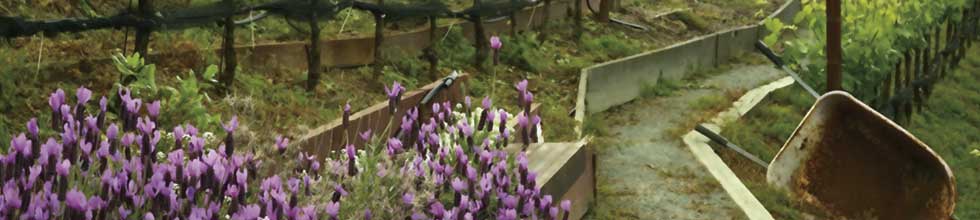
 What’s Growing Out Back? Lamorinda’s Uniquely Local Wines
As you drive along Highway 24 past the East Bay suburbs of Lafayette and Orinda, if you look closely (and quickly) on the north-side of the freeway you will spot a couple of small grape vineyards nestled in the hills. Exit the highway and take either of the main arteries—Moraga Road or Moraga Way—until they intersect and you will find another vineyard perched on a ridge overlooking Moraga’s central shopping district. Over 100 vineyards dot the landscape throughout Lamorinda— the amalgamation of the Contra Costa County cities of Lafayette, Moraga, and Orinda. Yet most of the suburbs’ vineyards are hidden from view from the passing car, tucked away in back on the sloping hills that define the area’s terrain.
While much of Lamorinda’s suburban space is already developed and other green space protected, many residential properties have hillside areas, from an eighth of an acre to a couple of acres in size, suitable for growing grapevines and little else. These are not the vast vineyards of Napa and Sonoma. Lamorinda’s grapes are growing right in residents’ backyards. “That is what makes our winegrowers so intriguing,” says Susan Captain, President of the Lamorinda Winegrowers Association. “We are suburban farmers.”
You can catch a glimpse of Bill Scanlin’s vineyard from the BART station in Lafayette. He planted the 585, mostly cabernet, vines that traverse his backyard 14 years ago. “We have a southern exposure and I thought the vines would help control the weeds and erosion and provide a nice backdrop,” says Scanlin. Known as Deerhill Vineyards, aptly named given the deer that often graze the empty lot just outside his fenced yard, Scanlin’s grape crop fills three large oak barrels in a good harvest, enough for 900 bottles of wine.
Scanlin makes his own wine, managing the entire process from picking and crushing the grapes to fermenting and bottling the wine. Along the way he has taken over parts of the family’s rec room and garage to house the operation. In 2009, Deerhill Vineyards became a bonded winery, which enables Scanlin to sell his wine. “Using my own locally-grown grapes is what makes the winemaking interesting for me,” says Scanlin. “We became a bonded winery with the aim to offset some of the costs of my interest,” he adds smiling.
Lamorinda’s history of winegrowing—cultivating grapes and producing wine—dates back over 125 years. Those old vines are long gone, but there has been a resurgence in winegrowing over the past decade. Susan Captain and her husband Sal, who own and operate the commercial winery Captain Vineyards in Moraga, attended the first gathering of the Lamorinda Winegrowers Association (“LWGA”) back in 2005 when they were just getting established as vintners. “There were about 15 growers there,” says Susan, “And we were really excited about the uniqueness of locally-grown and produced wine from Lamorinda.” As word spread, more and more vineyards started popping up in the area, and today the not-for-profit LWGA has 75 members.
Most of Lamorinda’s winegrowers are oenophiles with a hobby. They grow grapes and make wine for their own consumption and to share with friends. Without the demands of a commercial venture, they are free to grow the grapes they want to make the wine they like.
Tom Morehouse’s vineyard in Orinda has 208 vines split among three varieties: ½ syrah, ¼ mourvedre, and ¼ grenache, so he can make a southern Rhone-style blend, a light red that he finds pairs well with many dishes. The grapes make a winning combination, but his suburban vineyard has its challenges. “The ideal location for a vineyard is a southern exposure,” says Morehouse, “Mine faces north. But my house is where my house is.” While he might prefer a bit more sun, Morehouse produces wine that both he and many friends enjoy.
As grape growing and wine making has found its niche in Lamorinda, the growers have formed a loose network and often collaborate. The 300 vines in Mary Leigh Miller’s backyard in Moraga abut directly with her neighbor’s similar-sized vineyard up the hill. The neighbors work together and recruit friends and other growers to help with the harvest. Miller combines her sangiovese grapes with the cabernet and syrah grapes from another vineyard in Lafayette and outsources the wine production to an Orinda-based vintner. The end product according to Miller is a “super Tuscan”.
“From the outset our mission has been to support each other to grow the best grapes and make the best wine that we can,” says Susan Captain. The area’s temperate climate with cool evenings and hot summer days, less foggy, wet and cold than its neighbors on the west side of the Caldecott Tunnel, is just right for a number of grape varietals, particularly reds. The heavy clay soil and sandstone base drains well due to the steep hillsides, and there is limited risk of frost or early rains, which provides a long growing season for the red grapes that prefer an extended time on the vine. “Our wines have a distinct taste because of our unique location and climate,” adds Captain. To further establish the area as a distinct winegrowing region, the LWGA is working toward Lamorinda’s designation as an American Viticultural Area “AVA”.
“It’s all about quality, I want to make wine of really great quality,” says Paul Coletta, one of Lamorinda’s newest winegrowers. So when he decided to add a vineyard to his Orinda property, he did his homework. Before choosing what varieties to plant, he carefully analyzed the climate patterns and had the soil tested. Paul is an expert on food branding and serves on the Executive Board of the Robert Mondavi Institute for Wine and Food Science at U.C. Davis, so he also tapped his colleagues to help him choose the best grapes to grow in his vineyard. Coletta lives on a semi-circular ridge, which creates a warm, sunny buffer for his 500 syrah and viognier grapevines. The first bottle of this classic northern Rhone blend from Coletta’s Humblebee Vineyard will be ready to drink in the spring of next year.
A nascent cottage industry has begun to emerge as winegrowing has taken root in Lamorinda. Today, there are six commercial wineries in the area that sell their wines online and at local wine stores and restaurants. But the volume of wine produced is limited. The maximum capacity of the two largest bonded wineries, both located in Moraga, is about 1,000 cases each, a tiny fraction of what commercial wineries in northern wine country produce. Huge profit is not the goal. Winegrowers in Lamorinda who have commercialized their ventures aim to cover their costs and then enjoy their uniquely, local wine.
“Lamorinda is the perfect location for a boutique winegrowing region,” says Dave Parker who runs the bonded winery Parkmon Vineyards with his wife Shari from his home in Moraga. “The goal has never been to become another Napa,” says Parker. “The vision is to produce hand-crafted, artisan wines,” says Shari, finishing his thought. “It’s a co-op concept. It fits the local culture.”
Lamorinda Wines—Judges Take Notice
“Contra Costa County may not be as well known for winegrowing as some of the other regions in the area like Napa, Solano or Medocino, but there are many places in this county well-suited to produce high-quality grapes and world-class wines” says Dave Parker the owner of Parkmon Vineyards in Moraga.
Already several wines from Lamorinda have been recognized at club and regional wine competitions. The wines from Parkmon Vineyards have medalled each year for the past four years in the San Francisco Chronicle Wine Competition. Most recently Parkmon’s 2008 Sangiovese won Best of Show in the Contra Costa Winegrowers Commercial Wine Competition.
“We were excited to enter our wines in this competition which was exclusive to varietals grown in Contra Costa County,” says Parker. Parkmon’s Sangiovese grapes were sourced from Koelmel Vineyard in Lafayette, one of the older vineyards in Lamorinda, established about 15 years ago. Parkmon’s 2008 Petitie Verdot also won a gold medal in the competition and several other wines from the winery received silver and bronze medals. Parker is very pleased with the recognition his wines received and hopes this will help spread the word about Lamorinda’s wines. “We are a small close-knit winegrowing community, and we support and promote each other,” says Parker, “I think that is how most successful winegrowing regions get started.”
 Andrea Firth is a freelance writer based in Moraga with her husband, two teens, and a dog named Pepsi.
[weaver_extra_menu menu=’foodMenu’ style=’menu-horizontal’ width=’100%’ css=’menu-horizontal’]
Tales of the Kitchen
Chef K. Marie Paulk
I was having a difficult time trying to decide on the subject of this month’s story. I was standing in line to pay for my purchase at Whole Foods when I was approached by one of their vendors who was sampling a new product. It just happened to be one of my greatest weaknesses – an organic peanut butter cup. It really didn’t need to be organic, anything with peanut butter and chocolate and I am sold. That is when the light went on and I knew my subject should be chocolate. We can thank the Aztecs and Mayans for the discovery of the cocoa bean. They were the first who used it as a drink by splitting the bean open and mixing it with water. They called it Xocolat, translation “bitter water”. The tree was known as Theobroma Cacao, translation “food of the gods”. The cocoa tree grows in humid, tropical places likes Madagascar, East and West Indies, Africa, South Pacific Islands, the Caribbean and Hawaii. It is an evergreen tree that blooms all year round. The tiny flowers can be white, pink, yellow, red or even two toned. The pods grow directly on the trunk of the tree. The pod can be smooth or deeply ridged. The pods are broken open and contain 20 to 50 cocoa beans each. The beans are dried and fermented to begin the transformation into a long list of products: chocolate bars, ice cream, baking chocolate and hot chocolate. Like grapes and coffee beans, the cocoa bean develops different characteristics depending on the region in which they are grown, known as the terroir. There are three main types of cocoa beans:
1. Forastero, which is the workhorse of the cocoa beans. Some of the trees are cultivated for 50 years. There is little flavor and aroma, but it is the heartiest of all beans. It is grown mainly in Africa and Brazil.
2. Criollo is the rarest of all beans. It has the best flavor and aroma and the trees are extremely fragile. A chocolate manufacturer in Venezuela, El Ray, produces an excellent chocolate using only criollo beans. The tree is grown mainly in Venezuela and South Africa.
3. Trinitario is a cross between the Forastero and Criollo bean. The flavor and aroma is average. These trees are gown mainly in Trinidad and Ecuador.
When researching for this article I remembered that, like bread making, there are 12 steps in the manufacturing of chocolate.
1. Harvesting: Beans are handpicked, which explains why cocoa is so expensive. Harvesting is done twice a year.
2. Fermentation: Pods are split open and the pulp, which holds the beans, is scooped out and placed on wooden crates or banana leaves to dry. This takes about three to seven days. The pulp, which is sugar, ignites the fermentation.
3. Drying: The beans are sun dried.
4. Cleaning: Beans are cleaned by air.
5. Bagging and Selling: Beans are inspected and given a grade. There are 3 classes: fine, second and third, which is determined by the color of the bean. The beans are sold to a manufacturer, which takes over the process.
6. Roasted: This is done to enhance the flavor. The time and roasting process is determined by the manufacturer.
7. Hulling: The beans are mechanically cleaned by cracking them open and removing the meat of the bean. This is called the “nib”, which is 55% cocoa butter.
8. Liquor Mill: The nibs are processed under metal rollers and heat to produce the chocolate liquor. From the chocolate liquor, cocoa butter and pressed cakes are produced. Cocoa butter is sold for beauty products and medicine. The pressed cakes are pulverized and sifted to produce the cocoa powder. Alkali is added to the cocoa powder, which neutralizes the acidity in cocoa powder, producing Dutch cocoa which is used for baking.
9. Blending: From cocoa powder there are recipes followed by each manufacturer, which will develop the following: a. unsweetened/baking chocolate; b. semi-sweet chocolate; c. milk chocolate; and/or d. couverture chocolate (this is coating chocolate).
10. Conching: The chocolate is refined through constant moving with shell like rollers, from which the method is derived. It is then massaged and kneaded, making a smoother end product.
11. Tempering: The chocolate is heated to realign the cocoa butter crystals. When the crystals cool, they form the structure of properly tempered chocolate. Tempered chocolate sets quickly, it sets without streaks, is shiny and hard. It is starting to resemble the good stuff. Dark chocolate is set at 90° F and milk at 89° F. White chocolate, which is not considered a true chocolate since in contains no cocoa, is tempered to 88°. Each manufacturer most likely has their own tempering temperature depending on where the beans were grown, but this number has to be precise. This procedure has four different methods: seeding, tabling, direct and block. Basically all the methods require the chocolate to be reheated to 115° and then rapidly cooled to the temper temperature.
12. Molding and packaging: It is now ready for delivery to be enjoyed by all. This really is a very short summation of true chocolate manufacturing. So the next time you are enjoying a chocolate sundae or piece of candy you truly appreciate the labor, time and love that went into producing the sweet confection!

Watch for the Blue Moon at the end of the Month!
Ever mention something that happens “once in a blue moon”? Well brace yourselves—that moon will be here at the end of the month.
Tonight, August 1, is the month’s first full moon. But then we get a bonus as well, on the very last day: August 31 will showcase a second full moon, and this one will be blue. The last two-full-moon August occurred in 2008.
I love a full moon – people are stranger I know, but I think that’s what makes us tick a little better. It was great playing bocce as the moon came over the hills in Yountville, what a fabulous part of the world we live in. What a spread this group puts on, meats, cheeses, bread, wine, chocolate, cookies, I could go on and on. Thanks everyone for a great time.

The winning Bocce Team? Still undecided.
Today we film our second video for Local Happenings Live – it’s been fun and I am learning a lot. Stay tuned, Ben will make his debut as well.
SF Giants note – come on guys, snap out of it!
Stretches, feed Ben, latte, water the yard and I’m gone . . .
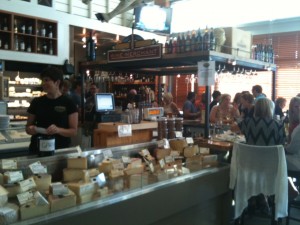
No bad economy at the Wine and Cheese Store!
Summertime is flying by and I can now take time to enjoy it a little more since one more issue is off of my desk! The new Local Happenings Magazine, August/September edition will be hitting streets on Friday. I am either becoming more patient and calm, have the system down or I’m doing it in my sleep since I really do not feel like life stopped during the production of this magazine. I was even at the Oxbow Market eating oysters last night at Hog Island which I never would have been able to do the night before we go to press last year. I will add it up to mental and spiritual growth. I guess that meditating is working.
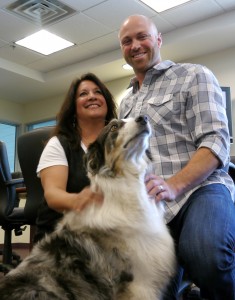
Bye Nate, Ben and I will continue to watch your career!
My Giants note – WE WON!!! Thankfully we broke our losing streak. My man Nate Shierholtz took off and went to Philadelphia last night – good luck and hopefully Hunter will do us right!
LOTS OF BIG stretches, feed Ben, latte, water the yard and I’m gone . . .

They always give me torture, but I love my Giants!
I don’t know why it is, but every time I have a deadline for the magazine someone else wants another job at the same time. I guess that is part of Murphy’s Law. Oh well, “c’est la vie”!
More writing, and designing – can I go to press today?!
LOTS OF BIG stretches, feed Ben, latte, water the yard and I’m gone . . .

Triple Cream Brie, A Perfect Meal!
The past 10 days are like a blur to me. I believe I haven’t touched ground once. I’ve been to wineries, restaurants, golf tournaments, dog excursions, horse adventures, events with friends and family, and home. Been fun but now I have to buckle down and get this issue off of my desk and to the public. Ben and I are doing what we love best – nesting.
Writing, designing and getting approvals on ads – that is my agenda for today so let’s get going!
BIG stretches, feed Ben, latte, water the yard and I’m gone . . .
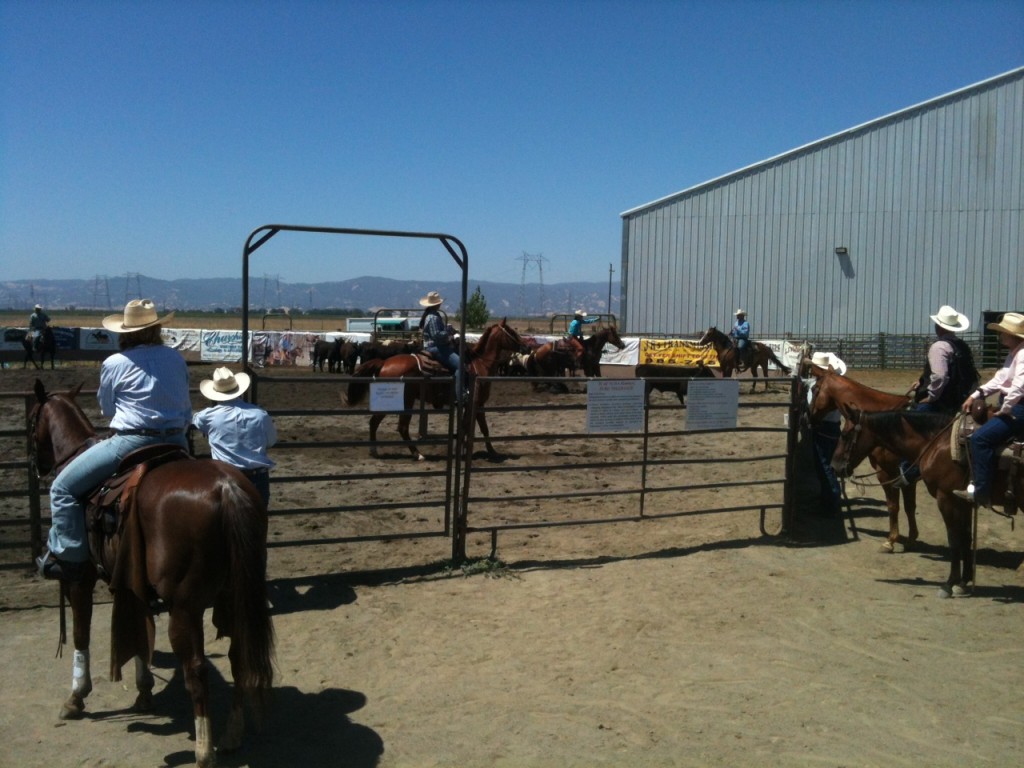
Getting down on the cow and having fun! (The one in blue.)
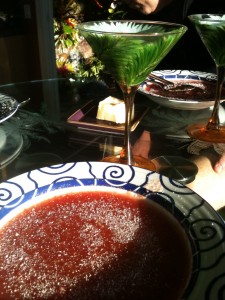
A perfect meal!
Yesterday I came face to face with how short life is, sadness and regret can overwhelm you. Be sure to always be true to your feelings and let your loved ones know the love in your heart since we only get one chance at this thing called life.
Benicia, Yountville, Vallejo and Walnut Creek were all visited yesterday and I don’t believe I walked in my door until almost midnight – very drained and tired today! Unfortunately a lot of work to do, so no rest for Ben or I.
Lots of stretches, feed Ben, latte, water the yard and I’m gone . . .

Kathy Gillian and Mike Browne steal Ben as soon as they see him!
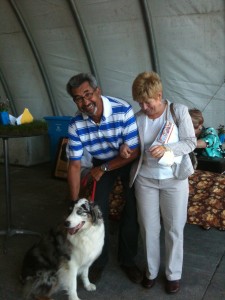
Ben greets Rudy and Marilyn Manfredi at the Vallejo Chamber Mixer

Ben loves his view!
Are the days getting shorter? I know they are, but they really are flying by! I have so much to do – where is the time I need? I guess I just have to keep trudging along to get all this work done.
Long day today after a long day yesterday! I am feeling sleep deprived, can I have a quiet evening soon? I am feeling like I need a little R&R. Today I have a three county day, so let’s get going!
Stretches, feed Ben, latte, water the yard and I’m gone . . .